⏱ About 10 min read
How Fermented Foods and "Healthy Longevity" Connect: A Review Paper Organizing the Mechanisms Behind Aging
“Fermented foods are good for you.” “They’re the secret to long life.” We hear these things all the time.
Miso, natto, pickles, yogurt, kimchi. Walk through the kitchens of the world’s longest-living regions, and you’ll find fermented foods on nearly every table. From there, the idea has long taken root: “Could fermented foods be connected to healthy longevity?”
But if fermented foods really do play a role in living long and well, what exactly is happening inside our bodies? A review paper published in December 2025 in the academic journal Current Research in Food Science organized these “mechanisms”—the actual biological processes at work—based on the latest scientific evidence (Paper title: “The role of fermented foods in healthy longevity: A review of potential anti-aging mechanisms,” DOI: 10.1016/j.crfs.2025.101300).
Today, I’d like to walk you through how this paper lays out the connection between fermented foods and the mechanisms of aging, in a way that’s easy to follow.
But let me be clear about something from the start. This is a review paper—it gathers existing research and organizes the mechanisms. It does not prove that “eating fermented foods makes you live longer.” It simply shows us “here are the mechanisms we think might be at work,” giving us a picture of the research landscape as it currently stands.
About this article: This article introduces research findings and does not guarantee the efficacy, health benefits, or anti-aging effects of any specific food. This paper is a review that organizes mechanisms; it does not prove that eating fermented foods extends human lifespan. For questions about health or medical conditions, please consult a healthcare provider or specialist.
Three Key Angles on Aging
The paper organizes three main ways that fermented foods might connect to aging. Let’s look at them one by one.
The paper identifies “oxidative stress” and “chronic low-grade inflammation” as major factors underlying aging. And woven deeply into both of these, the paper says, is “gut health.” These three work together, influencing each other, and all play a role in the aging process.
The broader framework of the paper is this: fermented foods potentially engage with all three of these angles in some way.
Angle 1: The Possibility of Easing Oxidative Stress
Let’s start with oxidative stress.
Oxidative stress refers to a state where “free radicals” build up excessively in the body, causing cumulative damage to cells. The paper positions this as “one of the major factors in aging and related diseases.”
According to the paper, fermented foods might relate to oxidative stress in these ways:
- Antioxidant compounds: During fermentation, compounds like phenols and flavonoids—associated with antioxidant activity—can increase (the paper cites reports of these rising in fermented grains, for example)
- Connection to the body’s own antioxidant systems: Fermented foods may influence how well the body’s built-in antioxidant mechanisms work (enzymes like SOD and catalase)
For instance, the paper mentions findings that “kimchi reduced free radical production and increased the activity of antioxidant enzymes.” But keep in mind: these come from research at various levels—cell cultures, animal studies—and we haven’t confirmed that the same thing necessarily happens in human bodies.
Angle 2: Connection to Chronic Inflammation (“Inflammaging”)
The second angle is inflammation.
In recent years, a concept called “inflammaging” has come into focus as a central factor in aging. It’s a blend of the words “inflammation” and “aging,” and it describes a state where the body experiences persistent, low-grade inflammation as we get older.
The paper organizes how fermented foods might relate to this chronic inflammation:
- Effects on inflammatory molecules: Fermented foods might work to reduce substances like TNF-α and IL-1β, which drive inflammation
- Maintaining the gut barrier: By preserving the integrity of the intestinal wall, fermented foods may help prevent unwanted substances from leaking into the bloodstream
Inflammation and oxidative stress reinforce each other. The paper’s view is that fermented foods might break into this “vicious cycle” in some way. But again, we’re talking about possibilities at the research stage—nothing settled.
Angle 3: Connection to Gut Health
The third angle—and the one the paper treats as the most important “upstream control point”—is “gut health.”
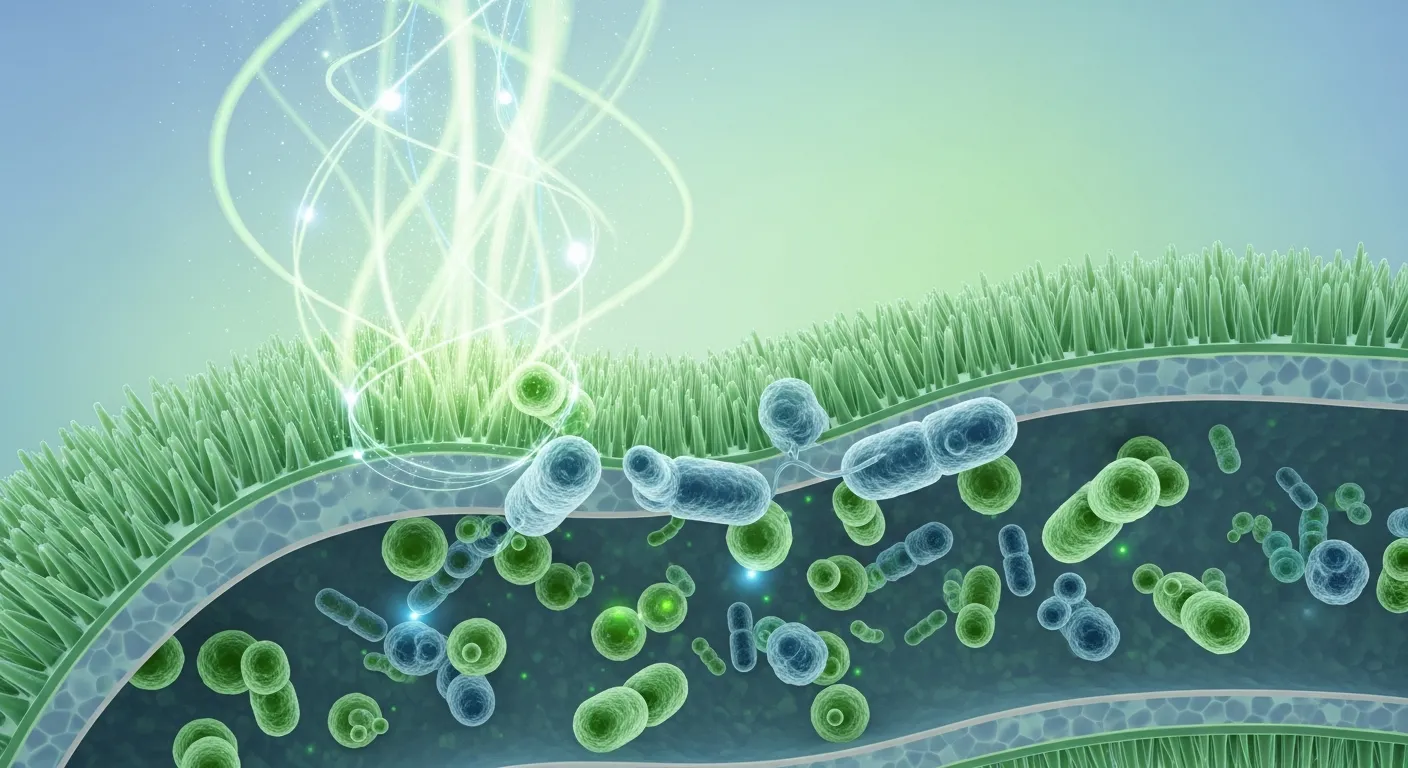
Fermented foods contain microorganisms like lactic acid bacteria, along with compounds their activity produces. The paper outlines these potential ways they influence the gut:
- Growth of beneficial bacteria: Microbes like Lactobacillus and the increasingly researched Akkermansia can increase
- Short-chain fatty acid production: Gut bacteria ferment fiber and other substrates to produce “short-chain fatty acids” (like butyric acid), which may influence immune function and metabolism
- Bacterial diversity: Fermented foods may support a more balanced and diverse microbial community
Gut health connects deeply to both oxidative stress and inflammation. This is why the paper takes an integrated view: by starting with gut health, we can potentially influence multiple aging-related factors.
What Matters Most: This Is Still Hypothesis
This is the part I want to emphasize most strongly.
This paper is, fundamentally, a review that organizes mechanisms. Much of the evidence it presents comes from cell studies, animal experiments, and research using model organisms like C. elegans (roundworms). It is not a long-term human study proving that “eating fermented foods extends lifespan.”
The phrase “healthy longevity” sounds appealing, but we shouldn’t rush to tie it directly to human lifespan. The paper itself lists future challenges as: “human studies” and “clarifying the dose-response relationship”—how much you need to eat, and what effects follow.
Fermented foods are not medicine. They’re simply part of our diet. We should avoid thinking, “If I eat this, aging will stop.”
The Paper’s Cautions Are Worth Noting Too
What’s admirable about this paper is that it honestly addresses the risks and limitations of fermented foods. This part is especially important when thinking clearly about healthy longevity.
The paper flags these cautions:
- High sodium content: Traditional fermented foods often contain significant salt, and excess consumption can burden the cardiovascular system (miso, pickles, and kimchi deserve special attention here)
- Compounds like histamine: If fermentation isn’t properly managed, histamine and tyramine can accumulate, potentially causing headaches or blood pressure spikes
- Difficulty in standardization: Fermented foods vary widely depending on how they’re made and which batch you get. It’s hard to say with certainty “this component does this much.”
In other words: “Fermented foods = automatically good for you” is not a reliable equation. We need to watch our sodium, eat in balance, and enjoy them in reasonable amounts—the basics still matter.
A Healthy Way to Enjoy Fermented Foods
After all these careful disclaimers, this paper still presents fermented foods in a positive light.
Oxidative stress, chronic inflammation, gut health. The paper draws a “map” of aging-related factors based on current knowledge, showing how fermented foods might touch all of them. That’s a meaningful contribution to future research.
What we can do is avoid taking this knowledge to mean “eat fermented foods and you’ll live longer.” Instead, we can “enjoy fermented foods as part of a balanced diet, while being mindful of salt and other considerations.” No unrealistic hope, no needless worry. Delicious, comfortable, sustainable. That’s what a healthy relationship with fermented foods looks like.
The reason fermented foods appear at tables in the world’s longest-living regions may not be that they’re a special superfood, but that they naturally fit into daily meals and represent a food culture that people actually stick with over decades. This paper lets us glimpse some of the mechanisms that might support that.
Fermented foods aren’t magic. But they settle gently into the everyday table—and perhaps the joy of that sustained presence is itself a kind of richness.
From Toshi
Reading this review paper, I realized that the relationship between fermented foods and healthy longevity is more complex than I’d thought. You can’t simply say, “Eat this and you’ll live longer.”
Miso, natto, pickles, yogurt, kimchi—they’re all familiar foods, and there’s something reassuring about them. I’ve always felt that comfort too. But working through this article, I understood the importance of looking carefully at the body’s mechanisms—inflammation, oxidative stress, gut health—rather than relying on vague impressions alone.
What struck me most was learning that aging isn’t driven by just one thing. It’s not oxidative stress alone, or inflammation alone, or gut health alone. Each connects to the others, all affecting the body’s state. Fermented foods, too, don’t work through a single component. They function as a combination of microorganisms, compounds created through fermentation, and the food itself.
But here’s the most crucial point, and I want to keep coming back to it: this paper does not prove that “eating fermented foods extends your lifespan.” A review paper organizes existing research and shows what possibilities might be worth considering. It’s not the same as long-term human studies proving a conclusion.
Words like “anti-aging” and “healthy longevity” have real appeal. Everyone wants to age well and stay healthy as long as possible. Because of that appeal, we need to be especially careful with such language. Fermented foods aren’t medicine, and they don’t promise to reverse aging. They’re just part of what we eat every day, something to incorporate without strain.
What I appreciated about this paper was that it didn’t shy away from cautions and limitations. Traditional fermented foods often contain a lot of salt. Miso, pickles, and kimchi are delicious, but eating too much means too much sodium. Also, if fermentation isn’t properly controlled, compounds like histamine and tyramine can build up and become problematic. Fermented foods aren’t automatically good just because they’re fermented.
I like this kind of clear-eyed thinking. When talking about fermented foods’ appeal, it’s more honest to show the cautions alongside the benefits. In fact, that builds more trust. Since we’re talking about health, we need to avoid cherry-picking only the good news. We need to acknowledge what we still don’t know.
Fermented foods have been part of human life for a long time. Before refrigerators, they were both a preservation technique and a way to enrich the table. Now modern science is adding its perspective, slowly learning about gut health, inflammation, and oxidative stress through this lens. There’s something beautiful about where traditional food culture and contemporary research meet. That’s where fermentation’s fascination really lies.
For myself, I want to approach fermented foods not as a special health hack, but as one simple habit that helps organize my daily eating. A bowl of miso soup. Some natto. A few pickles on the side. Yogurt for breakfast. These aren’t dramatic interventions, but they help create a rhythm to life.
Of course, these alone don’t determine health. Diet overall, exercise, sleep, stress, age, individual body chemistry—it all adds up. I don’t rely only on fermented foods; I also keep running and jogging. A balanced diet, movement, good rest. No single thing decides health; it’s the accumulated weight of these small habits.
Jogging especially has become something that settles not just my body but my mind. Eating fermented foods and running—neither is a flashy health strategy, but both are sustainable daily habits I plan to keep.
That’s why I don’t put too much faith in fermented foods alone. The idea is to weave them naturally into life as a whole, without strain.
Through this article, I felt how much potential fermented foods still hold for research. And yet, I also felt the importance of not rushing potential toward conclusion. Have hope, but don’t declare certainty. Enjoy them, but don’t depend on them alone. That’s probably the right distance to maintain a long-term relationship with fermented foods.
Fermented foods aren’t a fountain of youth. But they settle into the everyday table with ease, bringing flavor, culture, and a world of microorganisms. Learning the science behind them little by little, I want to keep savoring them thoughtfully.
※ This article is based on personal experience and publicly available information. It is not intended to diagnose, treat, or prevent any disease. If you have health concerns, please consult a doctor or registered dietitian. See our Disclaimer.