⏱ About 10 min read
A "Microbial Catalog" of Fermented Foods Around the World is Taking Shape. The New Database "MiFoDB" Opens New Doors for Research
Miso, soy sauce, kimchi, cheese, yogurt, bread—
There are countless fermented foods throughout the world. And every single one of them is born from the work of microorganisms. Lactic acid bacteria, yeast, mold… In most fermented foods, these microorganisms work together in complex ways, creating flavor and preserving qualities.
But you might find this surprising: the full picture of the microorganisms living inside fermented foods remains largely unknown. We might understand that “there are lactic acid bacteria in there,” but figuring out exactly “which bacterial strains are present, in what quantities, and what they’re actually doing” turns out to be incredibly difficult.
In September 2025, a commentary (an explanatory article) was published in mSystems, an academic journal of the American Society for Microbiology, taking on exactly this challenge (paper title: “Rediscovering the wild: MiFoDB brings fermented food microbiomes into focus,” DOI: 10.1128/msystems.00599-25).
What was introduced is “MiFoDB”—an analytical workflow that includes a reference database for analyzing microorganisms in fermented foods. Today, I’d like to take a closer look at this research frontier.
I should note that this article covers topics about “research methods and databases” related to microorganisms, rather than promoting specific health effects of certain foods. I’d like you to read this as an article meant to help us understand how the science of fermented foods is advancing.
The Challenge of Studying Microorganisms in Fermented Foods
First, let me explain why studying microorganisms in fermented foods is so challenging.
Until now, when examining microorganisms in food and the environment, methods like “16S rRNA analysis” or “ITS analysis” have been commonly used. These work by reading a specific portion of a genetic sequence that all microorganisms share in common, allowing us to estimate what kinds of bacteria are present.
This approach is convenient, but it has limitations. According to the commentary, these methods often stop at “genus-level resolution.” A “genus” is a taxonomic category—for example, “Lactobacillus genus” is a broad grouping.
However, in fermented foods, bacteria even within the same genus can have quite different functions depending on the specific strain (a more detailed level of classification). Without knowing not just “which genus of bacteria is present,” but also “which specific strains exist, what genes they carry, and what they’re producing,” we can’t truly see the complete picture of fermentation.
The “Strain-Level” Resolution That MiFoDB Brings
This is where MiFoDB comes in.
According to the commentary, MiFoDB is a metagenomics workflow (a method that reads DNA from food samples all at once) that makes the following possible:
- Strain-level resolution: Identifying microorganisms at a finer level than just the genus
- Functional gene annotation: Understanding what kinds of metabolic functions the genes carried by each bacterium can perform
- Tracking microbes across substrates and over time: Following how microorganisms change with the fermentation materials and as time progresses
The foundation of MiFoDB is a reference database containing over 3,000 genomes. It’s been specifically designed for microorganisms involved in fermented foods, allowing for functional gene annotation. It’s designed not just to match against known microorganisms, but also to handle data that may include microbes that haven’t been fully characterized yet.
This makes it possible to investigate not just “what’s living in fermented foods,” but also “what those bacteria are actually doing,” at a much finer level of detail. It’s a tool that lets us see the complex phenomenon of fermentation with much higher resolution.
Getting Down to the Genes Behind “Aroma” and “Flavor”
The commentary demonstrates the real potential of MiFoDB by introducing the identification of genes related to several compounds.
One example is genes related to “histamine.” Histamine is a compound that can be found in some fermented and aged foods, and it attracts attention from a food quality control perspective. If we can determine which bacteria carry genes involved in histamine production, that could help us better manage fermentation.
Another is genes related to “ethyl maltol.” Ethyl maltol is known as a compound with a sweet, toasty caramel-like aroma. If we can identify which bacteria in the fermentation process are involved in producing such aroma compounds, it deepens our understanding of how flavors develop.
With MiFoDB, we can now estimate the genes of microorganisms involved in the aromas and flavors of fermented foods. We’re entering an era where we can read fermented foods at the molecular and genetic level.
Why a “Database” Matters So Much
So why is having such a database so important?
In scientific research, any single team can only study so much. But when researchers around the world use the same “reference database” for their analysis, they can compare results and build upon each other’s work. Knowledge that was once scattered can now connect on a common foundation.
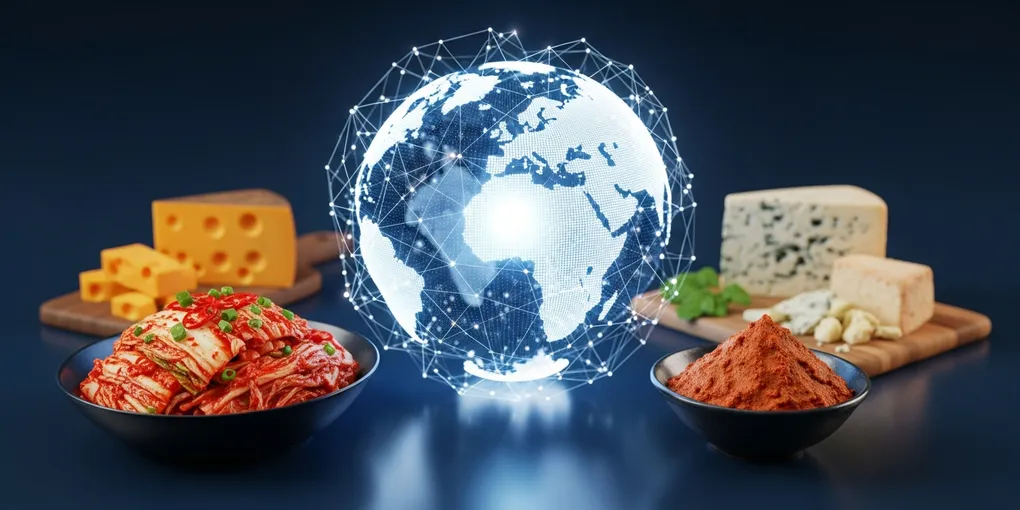
Fermented foods exist everywhere in the world—countless varieties in different regions. Miso and pickles from Japan, kimchi from Korea, cheese and bread from Europe, traditional fermented foods from Africa and the Middle East… These foods’ microorganisms are surely different in each region and each food type. If we can start examining all of them with a common measuring stick, recording what we find, and comparing results, then the full picture of fermented foods will gradually come into focus.
MiFoDB and databases like it are, in a sense, an attempt to create a “global catalog of fermented food microorganisms.” They transform individual discoveries into a map of knowledge that everyone can use. It might seem unglamorous, but this kind of foundational work is truly essential for the progress of science.
What This Means for Those of Us Who Love Fermented Foods
This research doesn’t directly demonstrate any specific health effects. Yet for those of us who love fermented foods, there’s a quiet kind of fascination to it.
The miso soup, cheese, and kimchi that we find delicious—behind every spoonful lies the complex activity of countless microorganisms. What was once described only through “vague experience” in the world of fermentation is slowly becoming something we can actually “see” thanks to databases like these.
Long ago, master craftspeople made fermented foods through experience and intuition, without ever knowing the names of microorganisms or understanding genes. Now, modern science is working to unravel their traditional techniques at the strain level and genetic level. There’s a special fascination in fermentation research that exists at the intersection where tradition meets cutting-edge technology.
Someday, when the microorganisms of fermented foods from around the world are compiled into a single catalog, we may be able to understand the fermented foods on our own tables much more deeply. As a step toward that future, I find myself quietly rooting for these painstaking efforts like MiFoDB.
In the world’s fermented foods, there are countless bacteria whose names we don’t yet know. Recording them one by one, turning them into a map. The science of fermentation is in the midst of this grand undertaking.
From Toshi
After reading this article, I felt how much of the world of fermented foods remains “unseen.”
Miso, soy sauce, kimchi, cheese, yogurt, bread—these are all foods we encounter in our everyday lives. Yet what exactly is happening inside them? Which bacterial strains are at work, and what roles do they play? We still don’t fully understand these things. When you think about it that way, the fermented foods on our daily tables suddenly start to look like tiny universes.
I think fermented foods have traditionally been described in terms like “delicious,” “keeps well,” and “has been considered good for the body since ancient times.” Of course, that kind of experiential perspective is also valuable. But efforts like MiFoDB are approaching fermented foods from a different angle—trying to examine them in finer detail, down to the level of bacterial strains and genes. I find it fascinating to see modern science turning a new eye on traditional food culture.
What struck me most was the focus not just on “what bacteria are present,” but on “what those bacteria are actually doing.” The flavors and aromas in fermented foods don’t appear by accident. They emerge as microorganisms break down sugars and proteins, and create compounds that form the basis of aroma. By investigating the genes and processes behind all this, our understanding of fermented foods deepens significantly.
At the same time, I think it’s important to be clear that this research doesn’t directly demonstrate health effects. Studying the microorganisms in fermented foods in detail may eventually lead to discoveries relevant to health and nutrition. But that doesn’t mean we can say “eating this fermented food will make you healthier.” I understood this article less as a discussion about the effects of eating fermented foods, and more as foundational research about how to study the microbial world happening inside them.
I believe this “foundational work” has tremendous value. When we think of notable research, we tend to focus on results like “this works” or “we discovered a new benefit.” But before we get there, there’s painstaking work: collecting data, organizing it, and putting it into a form that researchers worldwide can compare and build upon. Databases and analytical tools like MiFoDB are the very foundation that makes this possible. It might not be flashy, but this kind of work is what allows research to move forward.
Fermented foods exist all around the world. Miso and pickles from Japan, kimchi from Korea, cheese and bread from Europe, traditional fermented foods from the Middle East and Africa. Each has been passed down through generations in its own region, shaped by climate, local ingredients, and ways of life. The microorganisms living in them surely differ from region to region and food to food. If we could one day examine all of them with a common standard, recording and comparing what we find, I believe a map of fermented foods would gradually take shape.
I don’t think this kind of knowledge will belong only to researchers. The miso soup, natto, cheese, and bread on our own tables are part of that larger map. When we consider that our everyday food is connected to global fermentation practices and microbial research, even an ordinary spoonful takes on a deeper meaning.
The craftspeople of old made fermented foods without knowing words like “genes” or “bacterial strains,” guided instead by smell, temperature, touch, and the passage of time. The knowledge accumulated through their experience is truly remarkable. And now, science is slowly translating that invisible work into words and data. There’s something special about fermentation research happening at the point where traditional wisdom meets cutting-edge analytical technology.
Through this article, I realized I don’t want to see fermented foods just as “traditional things,” but as “living research topics where progress is still happening.” Miso, kimchi, cheese, bread—they’re completed foods, yes, but they also harbor a microbial world that’s still being uncovered.
Fermented foods offer not just the pleasure of eating, but also the joy of discovery. What bacteria are present? What are they doing? What aromas and flavors do they create? The more we understand these things, the more interesting fermented foods become.
From now on, I want to look at fermented foods not just as health information, but as something where culture, science, and daily life all intersect. A microbial catalog of the world’s fermented foods is being built, piece by piece. Perhaps that will lead us toward a future where we understand our own tables more deeply.
※ This article is based on personal experience and publicly available information. It is not intended to diagnose, treat, or prevent any disease. If you have health concerns, please consult a doctor or registered dietitian. See our Disclaimer.