⏱ About 12 min read
The Same Taste, Every Time | Science Takes On the Variability of Fermented Foods
You follow the same recipe, prepare everything the same way, yet somehow the flavor turns out different.
If you’ve ever made fermented foods, you’ve probably experienced this at least once. Miso, bread, cheese—they seem to show a slightly different face each time you make them. It’s part of what makes fermentation so fascinating, yet also what makes it so challenging.
Now, a major review article has been published that confronts this variability head-on with the power of science. Published in 2026 in Nature’s journal “npj Science of Food,” this research brings together experts from Ireland’s Teagasc Food Research Centre, University College Cork, and APC Microbiome Ireland, among others.
Today, I’d like to explore the future of fermented foods through the lens of this paper.
The Quality of Fermented Foods Comes Down to Microbes
Where does the deliciousness of fermented food come from?
The paper starts by clarifying that the quality of fermented foods is largely determined by “the composition, function, and interactions of microbial communities.” Which bacteria are present, how many there are, what they do, and how they influence one another—the combined result of all these factors gives rise to flavor, aroma, and texture.
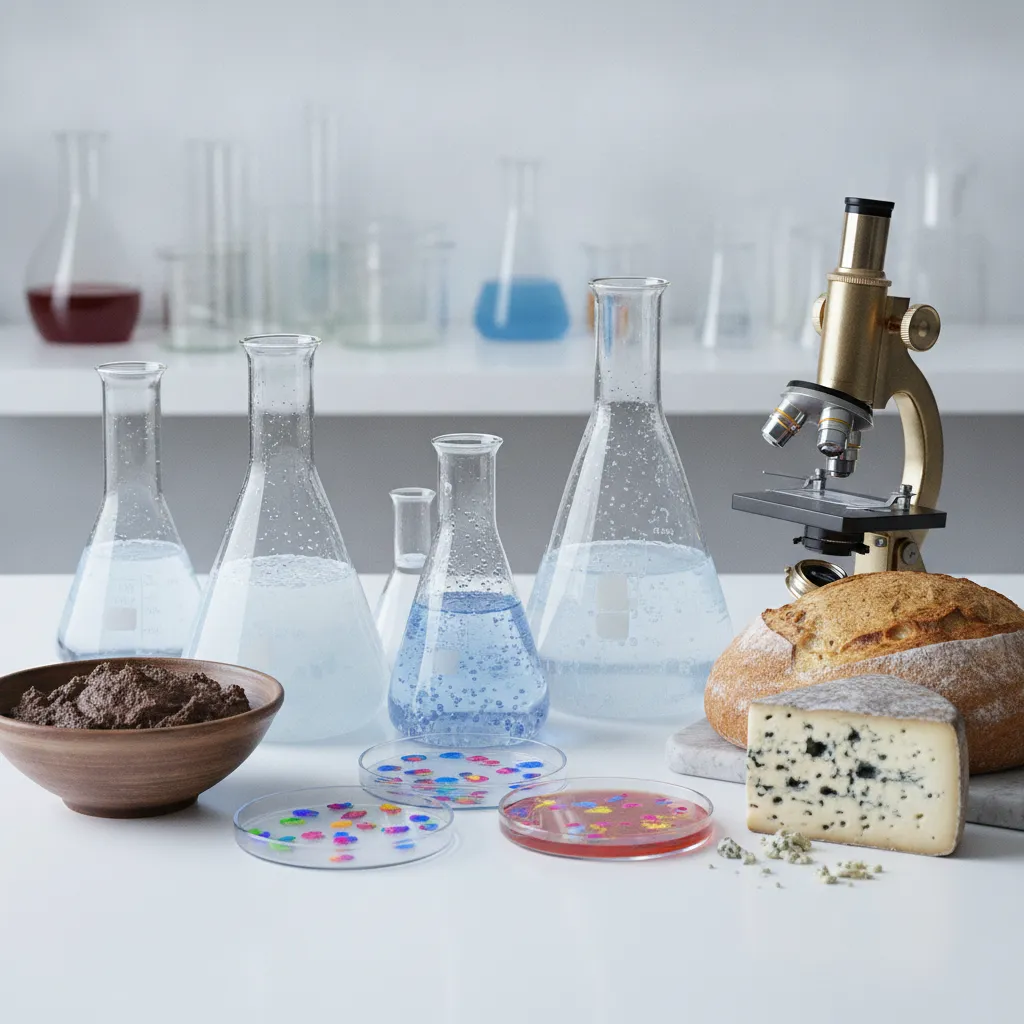
The trouble is, controlling which microbes show up is far easier said than done. The tiniest shifts in temperature, humidity, or raw materials can throw off the microbial balance. That’s why fermented foods naturally have high variability in composition and are difficult to control. Especially in industrial settings, where the goal is consistent, large-scale production, this “lack of reproducibility” has been a long-standing challenge.
Omics: A New Way of Seeing
Enter a technology called “omics.”
Since it’s an unfamiliar term, let me explain. Omics is an umbrella term for methods that comprehensively read biological information all at once. Metagenomics, for instance, examines the genes of all the microbes present together. Metabolomics analyzes the metabolic compounds that microbes produce in one go.
For the first time, we can visualize in detail “what’s actually happening during fermentation”—something that was invisible before. In a sense, it’s a new way of shining light into the black box of fermentation. Using this approach, researchers can now analyze the microbial ecosystem of fermented foods and even intentionally redesign it, according to the paper.
”Defined Microbial Consortia”: A Design Philosophy
The centerpiece of this review is the concept of “Defined Microbial Consortia” (DMC).
A consortium is simply a collection of different microbes. Rather than leaving fermentation to chance, the idea is to deliberately design a combination of microbes with specific roles assigned to each. While the concept of DMC itself isn’t entirely new, what this paper brings to the forefront is a framework for thinking about these microbial collections in two distinct layers, and a systematic process for designing and refining them.
The paper suggests breaking down a microbial community into two layers. First, there’s the “core microbiome”—the bacteria that handle the fundamental work of fermentation itself, the foundation, so to speak. Then there’s the “accessory microbiome”—bacteria that contribute to flavor diversity and fermentation stability, adding personality and richness.
The idea is that by establishing a consistent core, you ensure reproducibility, while the accessory microbes add depth and nuance. This two-layer structure, the thinking goes, is key to achieving both stability and deliciousness.
Assembly, Assessment, Redesign
The paper also presents an approach called “A-A-R.”
Assembly, Assessment, and Redesign. You assemble a combination of microbes, evaluate the results, and if things don’t work out, you redesign and try again. This cycle repeats many times as you inch closer to your ideal fermentation.
It’s similar to prototyping and refining in manufacturing. Rather than relying solely on intuition and experience, you optimize the microbial collection based on data. Through this iterative process, the paper argues, you can develop fermented foods with desired characteristics and produce them with high reproducibility.
The Future of Fermented Foods
The paper positions the combination of omics analysis and DMC design and refinement as one pathway toward reproducible “precision fermentation.” (Note: the term “precision fermentation” is used differently in other fields to refer to using microbes to produce specific compounds. Here, I’m using it in the context of this paper—precisely analyzing and designing the microbial communities of fermented foods.)
That said, most attempts to introduce DMC into actual food production are still at the conceptual or laboratory stage, and whether it can maintain stability at industrial scales remains to be seen. Additionally, many traditional fermented foods have manufacturing standards designed to preserve regional microbes and natural fermentation processes. For these foods, replacing the original microbial community with a designed one might not be permitted under current regulations. At this point, a more practical application of omics technology may be to study the microbial state in detail and use that information for quality control and food authentication, rather than replacing traditional microbes entirely.
Of course, part of the charm of traditional fermented foods lies in the slight variability that comes from regional microbes. The goal isn’t to make everything uniform. But to ensure stable quality, safety, and accessibility for many people, scientific design is equally essential.
Traditional wisdom and cutting-edge omics technology aren’t in opposition—they complement each other. The very fact that fermented foods with centuries of history are now the subject of cutting-edge research speaks to the profound depth of fermentation itself.
Next time you have a bowl of miso soup, take a moment to think about the researchers around the world sketching out microbial blueprints behind that single bowl.
From Toshi
Fermented foods like miso, soy sauce, sake, bread, and cheese each have their own distinctive flavor and aroma. Even foods with the same name taste slightly different depending on who makes them, where they’re made, and what season it is. I think that subtle variation is one of the great charms of fermented foods.
At the same time, when it comes to getting food to many people, you can’t just accept “a little different each time.” Some batches turn out delicious, while the next is too sour. The aroma isn’t quite right. Fermentation doesn’t proceed on schedule. In some cases, there’s even a risk that unwanted microbes could multiply.
For those who make fermented foods, the variability of fermentation is both an attraction and a significant challenge.
Reading this review, what struck me most was how it doesn’t view fermentation as “the work of a single bacterium,” but rather as a society created by multiple microorganisms.
Within fermented foods, many different microbes are at work—lactic acid bacteria, yeasts, acetic acid bacteria, koji mold. One bacterium breaks down sugars, and other bacteria use the compounds created in that process. Sometimes microbes help each other; sometimes they compete for nutrients and space.
Out of this complex web of relationships emerge flavor, aroma, color, and texture. Behind every bite that we find “delicious,” there’s invisible teamwork among countless microorganisms.
Until now, it’s been difficult to observe that teamwork in detail, so humans have relied on experience to manage fermentation. We check temperature, humidity, aroma, color, and feel, making judgments like “things are going well” or “I should lower the temperature a bit.” Master craftspeople with years of experience have learned to sense small changes that don’t show up on any meter.
Now, a new technology called omics is stepping in.
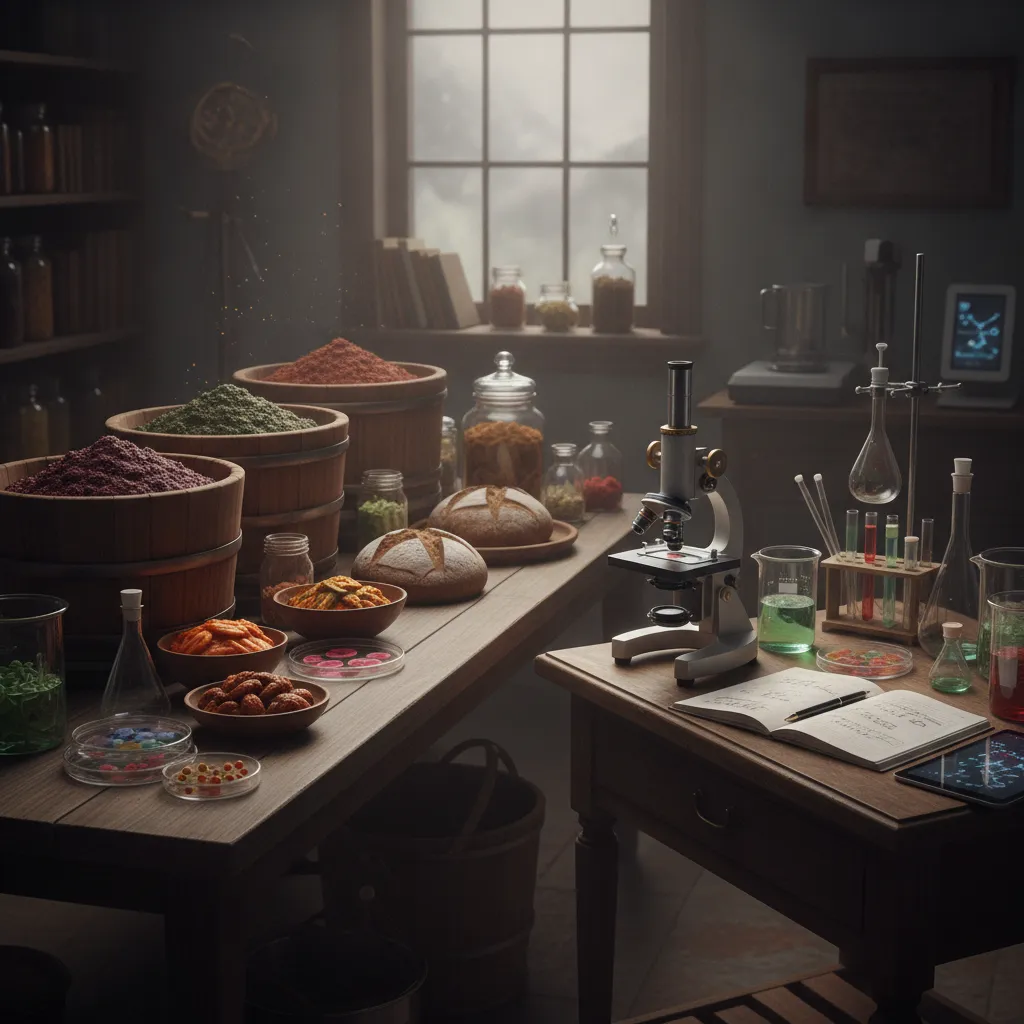
With metagenomics, you can identify what microorganisms are present and examine their genetic information all at once. Metatranscriptomics shows which genes are actually working. Metaproteomics reveals the proteins being made, and metabolomics identifies the compounds created during fermentation.
Then there’s culturomics, which involves cultivating the microbes found in food under various conditions and actually isolating and examining them.
No single method tells you everything. But by combining multiple approaches, you can gradually see not just “which bacteria are there,” but also “what those bacteria are doing” and “what compounds are being created.”
To me, this feels like a health checkup for fermented foods. Just as a doctor doesn’t rely on symptoms alone, but runs various tests to understand what’s happening inside the body, science is now trying to record in different ways what craftspeople have long sensed intuitively.
What I find particularly interesting is the concept of “Defined Microbial Consortia.”
Rather than using every naturally occurring bacterium as-is, the idea is to select the microbes needed for fermentation and design their combination. Within this combination, there are “core” bacteria that provide the foundation for complete fermentation, and “accessory” bacteria that add character through flavor and stability.
If I compare it to building a house, the core bacteria are like the columns and foundation, while the accessory bacteria are like the interior design and furnishings. You can’t build a house without a solid foundation, but a foundation alone doesn’t create the comfort and beauty that make a house feel like home.
Similarly, fermented foods probably can’t be completed with just the bacteria needed to drive stable fermentation. Complex aromas and layered flavors likely involve bacteria that don’t seem to be the main characters.
This doesn’t mean you should simply reduce the number of microbe species to make things simpler. The real question is how to maintain necessary functions while preserving diversity. How do you support both stability and character? The two-layer structure of core and accessory bacteria is a framework for thinking through that balance.
The A-A-R approach also reflects the fundamentals of manufacturing.
Combine the bacteria. Actually ferment and check the results. Then review what didn’t work and recombine. Assembly, assessment, redesign—repeating this cycle many times brings you closer to a microbial combination that meets your goal.
Rather than finding a perfect answer right away, you test, check, and adjust. While that sounds obvious when you put it into words, when you’re dealing with something as complex as microorganisms, this patient repetition becomes essential.
I don’t think this approach is fundamentally different from traditional craftsmanship.
Experienced craftspeople didn’t understand everything from their first batch either. They made fermented foods many times, learned from failures and successes, and adjusted their methods for different seasons and raw materials. Through that accumulation of experience, they honed their skills.
A-A-R might be seen as a way of recording that trial-and-error through data and making it easier for multiple people to share and learn from. Experience and science may not be opposed—they might just be different angles on the same fermentation.
That said, I don’t think all fermented foods should be made identical.
Foods produced at scale for many people need quality stability. If the same product tastes completely different every time you buy it, that’s a problem. To manufacture safely and maintain consistent quality, technology that helps us understand microbial state will be valuable.
On the other hand, fermented foods rooted in a region have a character born from that place’s climate, raw materials, storage vessels, tools, and the microbes that have taken up residence there. If we erase those differences, every miso and cheese in the world might end up tasting roughly the same.
There are variations we want to reduce and variations we want to preserve.
Changes that compromise safety, changes that lead to fermentation failure, changes that severely affect quality—these we should reduce. But subtle differences that create regional or artisanal character—these we should keep. The role of science isn’t to make everything uniform, but to tell the difference between these two kinds of variation.
Some traditional foods have standards set by law or regional regulations governing their ingredients and methods. Using natural fermentation or microbes native to a place might be fundamental to the food’s identity.
If you add bacteria from outside to such foods, or replace them with a designed microbial community, even if fermentation becomes more stable, the result may no longer qualify for the original food’s name.
So the applications of omics technology extend far beyond swapping out microbes. You can document which bacteria live in traditional fermentation and how they work. You can detect unusual changes early. You can scientifically confirm the characteristics of different regions. You can verify that a food is authentic—made properly in its place of origin, not a counterfeit. There’s real value in these applications too.
When people hear “precision fermentation,” they might imagine a future where machines control everything and identical products are manufactured in massive quantities. But the direction this paper points toward is less simple than that.
We haven’t yet reached a stage where we can manipulate microorganisms freely. Most DMC research exists at the conceptual or laboratory stage, and we still need to confirm whether what works in a small container will work the same way in large industrial settings.
A microbial combination that succeeds in a small container might not remain stable in a large-scale environment where raw materials, temperature, and oxygen levels differ. Whether the people eating the fermented food find it “delicious” can’t be determined by numbers alone.
Even as science advances, human perception and judgment remain essential in the end.
What I took away from this review is a vision not of tradition being erased by new technology, but of tradition being understood more deeply. Why does this particular brewery’s miso have this aroma? Why does fermentation differ by season even with the same methods? Science might gradually explain what lies behind the experience that’s been passed down through generations.
Rather than diminishing the value of a craftsperson’s knowledge, this would reveal just how finely they’ve learned to read subtle changes through experience.
Preserving the familiar flavor isn’t about keeping everything the same. As raw materials, climate, and manufacturing environments change, producers constantly innovate to deliver the same deliciousness.
Traditional wisdom, the work of microorganisms, and data from omics—these three pillars can support one another. Through their mutual support, fermented foods will continue to be passed down.
The goal isn’t to eliminate all variability, but to identify which individuality should be preserved while reducing the instability we want to minimize. That’s the kind of science I want to believe in.
Toshi / 56 years old, passionate about fermentation, health, and running
※ This article is based on personal experience and publicly available information. It is not intended to diagnose, treat, or prevent any disease. If you have health concerns, please consult a doctor or registered dietitian. See our Disclaimer.