⏱ About 14 min read
Miso's "Bioregulatory Functions": What Has Research Actually Revealed? | From 1997 Research Records
About This Article: This article introduces past research on miso (animal experiments using rats). It does not demonstrate that any particular food can prevent or treat disease (including cancer), nor is it medical advice. The research summary presented here was registered in 1997 and is not a peer-reviewed paper itself. Additionally, regarding miso specifically, the content does not show statistically significant differences compared to control groups. Miso is also a food high in salt. If you have concerns about your health or treatment, please consult with a medical professional rather than deciding on your own.
Miso soup, pickled miso, miso sauce.
Miso is a fermented food deeply rooted in the Japanese table. And precisely because it’s such a familiar food, its biological effects on the body—a property called “bioregulatory function”—has long been the subject of research.
Some of this research has been conducted with public research funding. In the records of the Ministry of Health, Labour and Welfare’s scientific research, there remains a project titled “Research on the Influence of Fermented Foods, Particularly Miso, on Bioregulatory Functions.” The lead researcher was Akihiro Itoh from the Institute of Atomic Bomb Disease and Radiation Medicine at Hiroshima University.
This research project began in fiscal year 1995 and was planned to continue through fiscal year 2000. What I’m referencing today is the summary registered as an overview for fiscal year 1997.
In this article, I’d like to use this record as a starting point to explore how miso’s functional properties have been investigated, and how we should understand the results.
Miso’s Functionality Has Been Studied Through Public Research
Miso’s functional properties have been examined not only by individual companies and researchers, but also through publicly funded research. The project we’re discussing today is one such example.
The accumulation of such research has occurred against a backdrop where miso has a long history and has been eaten by many people. Because it’s a familiar food that people encounter frequently, there’s value in scientifically confirming its properties—that’s the thinking that has driven these efforts.
For Japanese people, miso is far more than just a seasoning. It reflects regional food cultures and has supported the distinctive flavors of home cooking. Because of this cultural weight, various attempts to examine miso’s effects through the lens of science have been repeated in different forms.
However, I want to be clear from the start: “having been researched” and “having had its effects proven” are entirely different things.
It should also be noted that inclusion in a database or implementation through public research funding does not mean the Ministry of Health, Labour and Welfare has officially recognized or guaranteed miso’s health benefits. Furthermore, my reference here is a research summary, not a peer-reviewed paper itself.
What Was Investigated Through Animal Experiments
The research in question was conducted primarily using rats as test subjects.
What was investigated included miso, soybeans, and “biochanin A,” one of the plant-derived flavonoids that became a research focus. The research aimed to experimentally examine the potential of foods related to miso for chemically preventing cancer.
In experiments using rats administered carcinogens, the incidence rate of mammary tumors was reported as 10% in the 10% dried red miso group compared to 80% in the control group, showing a numerically lower value. However, in this summary, it cannot be confirmed that a statistically significant difference from the control group was demonstrated for the miso group. Statistical significance is clearly stated primarily for the biochanin A group.
This is a crucial point. “The numbers were lower” and “a statistically meaningful difference was confirmed” are two different things. For miso itself, it cannot be said that the latter can be confirmed. It would be incorrect to read this as “miso showed a suppressive effect” while glossing over this distinction.
Recognizing This as “Animal Experimentation”
First, this is an experiment using rats. It is not research that verified the same effects occur when humans eat miso.
Results seen in animal experiments don’t necessarily translate directly to humans. Body systems, food quantities consumed, and ways of living are completely different between humans and rats. In the scientific world, it’s not uncommon for promising results in animals to not be confirmed in subsequent human studies.
Furthermore, in experiments, specific components or foods are administered under controlled conditions. This differs fundamentally from the real-world situation where people consume various foods in varying amounts alongside other meals. There remains a significant gap between “possibilities” verified in the laboratory and “reality” at the dinner table.
Additionally, this research summary dates from fiscal year 1997—more than 20 years ago. It represents basic-stage research, and we cannot conclude from it that “miso prevents cancer.” Food is not medicine, and nothing has been shown to definitively prevent or treat specific diseases. This line of reasoning must never be lost sight of.
The Scientific Background of Miso as a Food
With those important reservations in mind, I’d like to organize some thoughts about miso itself.
Miso is made by taking soybeans and adding koji (mold spores) and salt, then allowing microorganisms to ferment the mixture. Soybeans are rich in protein and contain compounds like isoflavones. During fermentation, koji mold plays a central role, and depending on the production method, yeasts and lactic acid bacteria may also be involved. Through this process, umami and aromatic compounds are created, and the proteins in the soybeans are broken down into amino acids and other substances.
These compounds and the changes brought about through fermentation form the foundation of miso’s flavor and nutrition. The reason miso has long been a subject of research is partly due to this complexity and depth.
However, the fact that research explores the possibility that its components may be beneficial to the body is still a different matter from effects being scientifically established.
The Diversity That Cannot Be Lumped Under a Single Label of “Miso”
Another important point when considering miso is its remarkable diversity.
“Miso” as a category is not uniform in its contents. There’s a major division based on the type of koji used: rice miso (made with rice koji), barley miso (made with barley koji), and soybean miso (made with soybean koji). Beyond that, variations in salt content, fermentation duration, regional climate, and the unique microorganisms that inhabit each brewery all affect color and flavor.
Even though they’re all called by the single word “miso,” the components and taste vary from product to product. This is precisely why I want to be cautious about applying results from one research study of a particular miso to all miso. When reading research, it’s essential to look carefully at “which miso was studied, and under what conditions?”
Salt Content—A Critical Consideration
When discussing miso, we cannot overlook salt content.
Miso contains considerable salt for preservation and to manage the fermentation process. Although these foods often have a healthy image, excessive consumption can lead to salt overload. There’s a risk that increasing intake “because it seems good for health” will result in excessive salt consumption, so caution is needed.
Making a strong dashi broth and keeping the amount of miso modest, using plenty of ingredients, and limiting the amount of broth are time-tested approaches. These are practical wisdom for managing salt intake well.
This is especially important for those concerned about blood pressure or who’ve been advised by a doctor to reduce salt. Being interested in miso’s functional properties and paying attention to salt content are not contradictory—quite the opposite. It’s by being mindful of both that we can maintain a healthy long-term relationship with miso.
Understanding Research at Its Proper Scale
Miso is a fermented food with considerable depth that has supported Japanese food culture. The fact that its functional properties have been studied for a long time, including through public research, is itself an interesting reality.
However, much of this research consists of animal experiments or basic-stage studies, and doesn’t demonstrate effects in humans or disease prevention or treatment. As we’ve seen, there are aspects where statistically significant differences cannot be confirmed for miso itself. We need to clearly distinguish between possibilities we’ve discovered and facts that have been established.
This approach applies beyond miso. When we encounter claims like “X is effective for Y,” it helps to pause and look carefully at whether it’s from animal experiments or human research, and how thoroughly it has been verified statistically. Rather than being drawn in by striking headlines, calmly confirming what the research actually demonstrates is enormously helpful in navigating the flood of health information we encounter daily.
Rather than approaching miso with high expectations, it’s more natural to simply enjoy a bowl of miso soup as part of our food culture. Being careful about salt while enjoying it as part of daily meals without strain—I think that’s the most sensible way to maintain a relationship with miso.
Even without proven efficacy, miso’s deliciousness remains unchanged. The pleasure of savoring the aroma of a morning bowl or enjoying how it combines with ingredients—that simple joy is likely why miso has been passed down through generations.
From Toshi
Miso is simply too familiar a food for me.
I drink it as miso soup, use it to season dishes, and sometimes use it to pickle vegetables and meat. Without consciously thinking of it as a special health food, before I know it, miso is there on my daily table. Precisely because of this, when I hear that “miso has beneficial effects on the body,” I find myself wanting to believe it.
It’s a food with a long history that many people have continued eating, so surely it must have some special power? As someone who loves fermented foods, I understand the impulse to hold that expectation.
Reading through this research record made me feel that we don’t need to dismiss this expectation, but we do need to separate expectation from proof.
What I referenced is the 1997 fiscal year research summary included in the Ministry of Health, Labour and Welfare Scientific Research Outcomes Database. The research project began in 1995 and was planned to continue through 2000. As part of this, experimental results using rats fed miso, soybeans, and other substances are documented.
What’s important to note is that being listed in the Ministry of Health, Labour and Welfare’s Scientific Research Outcomes Database doesn’t mean the Ministry has officially certified its effects. Public funding for research and government endorsement of its effects are separate matters.
Additionally, what I’m referencing is a research summary, which by itself doesn’t represent current scientific conclusions. These distinctions are often unclear to those not specialized in research. I myself tend to feel there’s strong backing when I see terms like “Ministry of Health, Labour and Welfare” or “public research.”
That’s exactly why it’s crucial not to judge based only on credentials or the name of the research institution, but rather to look at what was actually studied and under what conditions.
In this experiment, rats administered carcinogenic substances were fed a diet containing 10% dried red miso for 18 weeks, and the incidence and number of mammary tumors were measured. This differs considerably from the situation where a person drinks miso soup in their normal diet.
The reported incidence of mammary tumors was 80% in the control group compared to 60% in the 10% dried red miso group. Looking at numbers alone, the miso group appears lower.
But I cannot say definitively that “miso suppressed tumors.” In the summary I reviewed, it cannot be confirmed that a statistically significant difference from the control group was demonstrated for the miso group. Statistical significance is specifically noted for the biochanin A group, the plant-derived compound that was the research focus.
By extracting just the numbers—“80% down to 60%“—one could certainly create an impressive headline. But whether that difference represents something beyond random variation is another matter entirely. Those communicating research have a responsibility not only to highlight the magnitude of numbers but also to examine what was statistically confirmed.
In scientific writing, the words “was lower,” “showed a relationship,” “a significant difference was confirmed,” and “effects were proven” all have different meanings. If we blur these distinctions, something still at the possibility stage can appear to be an established effect.
I believe it shows more respect for miso as a food to honestly write “the numerical values were lower, but statistically significant differences for the miso group could not be confirmed” than to present only results favorable to miso.
Miso is not a food that loses value if we don’t claim disease-preventive effects. Miso has value in its very deliciousness. Soybeans, koji, and salt transforming over time, creating umami and aroma—that process alone is sufficiently profound and worthy of discussion.
Rice miso, barley miso, soybean miso. Some misos are sweet while others have a strong salty taste; color and aroma change with fermentation duration. Even the same miso soup becomes something entirely different depending on which miso, dashi, and ingredients you use.
Appreciating that diversity is separate from making definitive claims about health effects. Because I love miso, I want to maintain an approach that doesn’t present research results as more significant than they truly are.
Of course, this doesn’t mean animal experiments like the one we discussed lack value. Before moving to human studies, it’s an important step in science to examine what biological changes might occur within a living body.
But that’s just one step. Human and rat physiology differ, as do the amounts consumed and living conditions. A possibility found in animal experiments may not be reproduced in humans. Furthermore, the diet used in this experiment contained a specific dried red miso at a particular proportion. Its results cannot be applied to all commercially available misos or to the miso soup people drink at home.
We should also consider the age of the research. Old research isn’t worthless because it’s old. Understanding what questions were asked in the past and what methods were used to investigate them has value in understanding research history.
On the other hand, we cannot discuss current health effects based solely on a research summary from more than 20 years ago. Did human research follow this study afterward? Were the same results found in other research? How have research methods and evaluation standards changed? Drawing current conclusions requires much more information.
And when it comes to miso, we must also address salt content.
If someone increases their miso intake “because it seems healthy,” their salt consumption rises proportionally. Rather than eating in extreme ways based on health hopes, it’s more practical to continue with reasonable strategies: using strong dashi, adding plenty of ingredients, limiting broth consumption.
Those advised by doctors to reduce salt should prioritize that medical guidance over general health information. The fact that miso is a fermented food doesn’t mean anyone should eat it in unlimited amounts.
Through this article, I’ve reaffirmed that there’s a substantial distance between “being researched” and “being proven.”
Research exists. That can spark interest. But effects on humans cannot be determined based solely on public funding, lower numbers, or changes observed in animals.
Communicating what remains unknown as unknown. Understanding possibilities at the scale they truly represent. That’s a bit unglamorous, but I believe it’s a deeply important approach when sharing information about health and food.
We don’t need to think of miso as a substitute for medicine. We don’t need to increase amounts based on expectation of special benefits. Enjoy it as part of our food culture, deliciously, while being mindful of salt content, as part of daily meals. That should be enough.
If research discovers new possibilities, I’ll observe them calmly. What hasn’t been proven, I’ll report honestly as unproven. And separately from scientific efficacy, I want to cherish the aroma and warmth of a bowl of miso soup.
The value of miso doesn’t diminish if we don’t speak grandly of its effects.
A single bowl of miso soup contains soybeans and koji and salt, the work of microorganisms, the experience of those who made it, regional culture, and time itself. While savoring that richness, I want to accept research findings only within the scope they actually demonstrate.
I want to maintain that kind of honest distance as I continue my relationship with miso going forward.
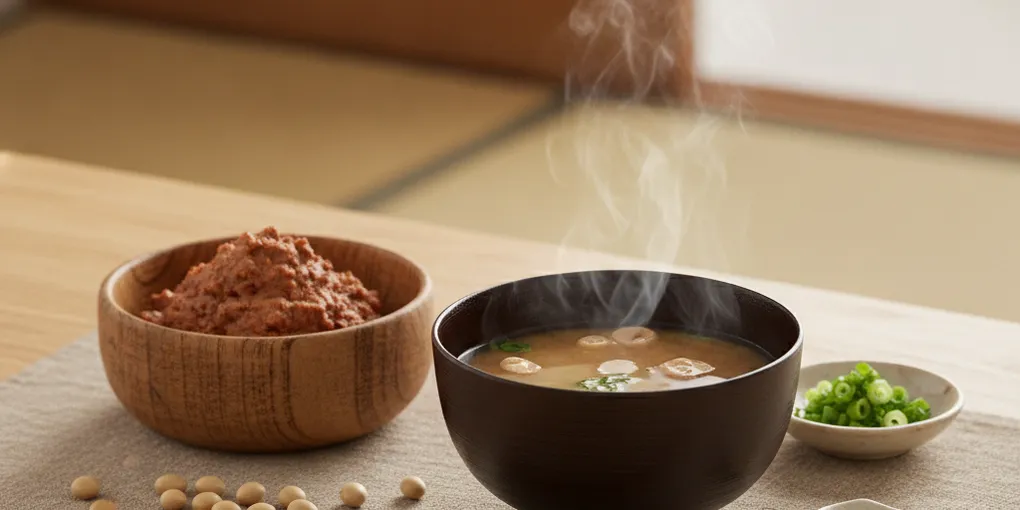
※The images in this article are miso and miso soup (representative images). They do not recreate the trial materials or consumption conditions used in the research.
The difference between what research “investigates” and what it “proves.” I want to quietly discern that distinction.
※ This article is based on personal experience and publicly available information. It is not intended to diagnose, treat, or prevent any disease. If you have health concerns, please consult a doctor or registered dietitian. See our Disclaimer.