
⏱ About 7 min read
Fermented Foods Are Not Just "Food"—They're a "System." A Comprehensive Look at Their Effects on Immunity, Metabolism, and Cognitive Function
“Fermented foods are good for you.”
We’ve heard those words for a long time. But there may have never been research that answered the question “why are they good for you?” with such systematic rigor.
On June 28, 2025, a review paper published in Foods, an academic journal of food science (MDPI), presented a comprehensive perspective that reframes fermented foods as “Functional Systems” (DOI: 10.3390/foods14132292). The authors—Inmyoung Park from Yonsei University and Mohamed Mannaa from Cairo University and Busan National University—conducted a cross-disciplinary analysis of clinical and preclinical research on fermented foods from around the world, including yogurt, kimchi, kefir, and sauerkraut.
What the paper shows is that the effects of fermented foods can’t possibly be summed up by saying “lactic acid bacteria are good for your gut.” Their influence extends throughout the entire body—affecting immunity, metabolism, and even cognitive function. However, this doesn’t mean every fermented food has the same effects. Rather, we need to read this as a complete picture that emerges when looking across multiple studies.
A New Way of Thinking: “Functional Systems”
The term “Functional Systems” in the paper’s title captures the essence of this research.
The traditional understanding of fermented foods was: “consuming probiotics—beneficial living microorganisms—creates a healthy gut environment.” That’s an important aspect, but it doesn’t fully explain what fermented foods are all about.
What fermented foods contain goes beyond probiotics alone. Through the chemical transformation process of fermentation, the food develops:
- Organic acids (lactic acid, acetic acid): Lower food pH, making it easier to inhibit spoilage and harmful bacteria
- Bacteriocins: Antimicrobial compounds that fight harmful bacteria
- Exopolysaccharides (EPS): Utilized by gut bacteria, potentially leading to short-chain fatty acid production
- Bioactive peptides: Diverse functional compounds involved in blood pressure, immunity, and metabolism
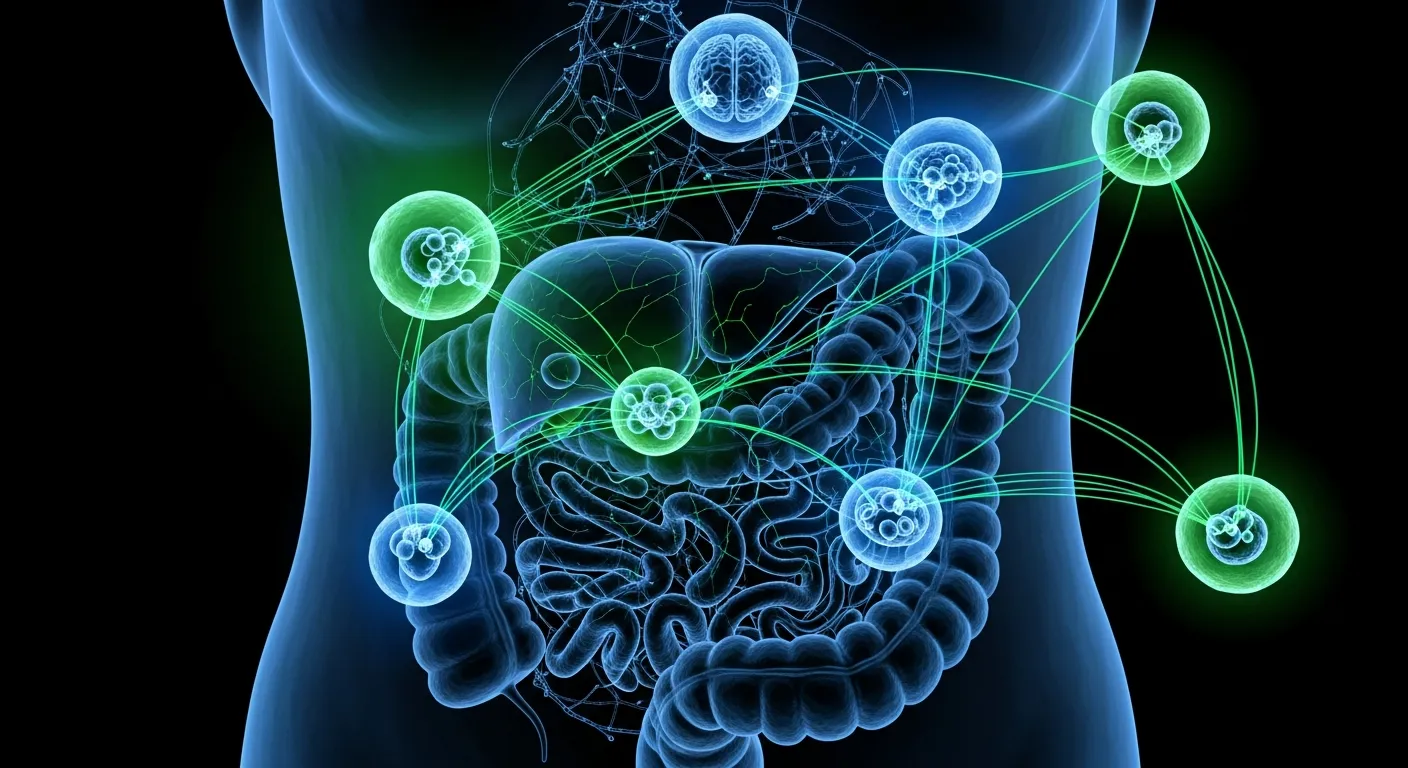
These interact with the microbial community in your gut and potentially influence your body through multiple pathways. It might be more accurate to say we’re “introducing a complex biochemical system into our body” rather than simply “eating food.”
Effects on Immunity—Reduced Inflammatory Markers and Enhanced Gut Barrier Function
The evidence for immune regulation that the paper summarizes is concrete.
Regular consumption of fermented foods has been shown in randomized controlled trials—such as a 10-week study on healthy adults—to reduce inflammatory cytokines like IL-6 and IL-12b. Given that chronic low-level inflammation is connected to lifestyle diseases and aging, these changes in inflammatory markers carry significant meaning.
There’s also emerging evidence of potential support for gut barrier function. When the intestinal mucosa functions as a “wall” that prevents harmful substances from entering, it may reduce the risk of conditions related to “leaky gut”—something we’ve discussed on this blog before. Short-chain fatty acids, particularly butyrate, are produced mainly when gut bacteria ferment fiber and other compounds. These serve as an energy source for intestinal epithelial cells and play a crucial role in maintaining this barrier. While fermented foods themselves may not contain large amounts of short-chain fatty acids, they may support their production in the gut.
Effects on Metabolism—Blood Sugar, Liver Fat, and Insulin Sensitivity
The relationship between fermented foods and metabolism is also systematically organized in the paper.
When data from clinical and preclinical studies are compiled, the following changes have been reported:
- Improved insulin sensitivity: Through short-chain fatty acid production by gut bacteria, there may be enhanced insulin sensitivity
- Reduced liver fat accumulation: Via the gut-liver axis, there may be suppression of fat accumulation in the liver
- Improved glucose tolerance: Possible involvement in blood sugar control
This connects to research we’ve covered on this blog before about “the gut-liver axis and MASLD (fatty liver disease).” Changes in gut environment can influence liver metabolism—that chain reaction is also identified as an important theme in this paper.
Effects on Neurocognitive Function—Latest Evidence on the “Gut-Brain Axis”
One particularly noteworthy aspect of this paper is its coverage of effects on neurocognitive function.
Studies cited in the paper report improved memory and cognitive test scores among groups who regularly consumed fermented dairy products.
This may relate to the mechanisms of the “Gut-Brain Axis.” Metabolic byproducts produced by gut bacteria, substances involved in neurotransmission like serotonin and GABA, the vagus nerve, and immune and inflammatory pathways are all being researched as potential bridges between the gut and brain. Additionally, the possibility that reduced inflammatory cytokines influence chronic brain inflammation is being explored.
The phrase “the gut is the second brain” is often used metaphorically, but the underlying bidirectional communication pathways between gut and brain are increasingly being systematically understood in neuroscience and microbiology.
Kimchi, Yogurt, Kefir—Characteristics of Different Fermented Foods
The paper analyzes the world’s representative fermented foods in particular detail.
Yogurt is primarily composed of Lactobacillus bulgaricus and Streptococcus thermophilus, with abundant evidence for immune regulation, calcium absorption promotion, and gut barrier enhancement.
Kimchi is a complex fermented food where diverse lactic acid bacteria like Leuconostoc, Lactobacillus, and Weissella coexist. Research on anti-inflammatory and anti-obesity effects continues to accumulate.
Kefir is fermented by kefir grains where lactic acid bacteria and yeast coexist, showing greater microbial diversity than other fermented dairy products. There are many research cases involving immune regulation, blood sugar improvement, and gut barrier enhancement.
The characteristics of these international fermented foods overlap significantly with traditional Japanese fermented foods like miso, nukadoko (fermented rice bran), and natto. Of course, different foods contain different microorganisms and metabolic byproducts, but the trait of “multiple microorganisms working together to produce diverse metabolic compounds” is common to Japanese fermented foods as well.
Personalized Nutrition as a Framework
What the latter part of the paper emphasizes is the importance of individual differences.
Even if two people eat the same fermented food, differences in their gut microbiota composition may result in different effects. The paper points out that “personalized nutritional strategies based on microbiome profiles” will be an important focus going forward.
This aligns with a perspective we explored before—that gut bacteria enzymes influence the effects of phytonutrients. In the future, understanding your own gut environment and choosing dietary habits suited to it may become increasingly important.
Summary
Fermented foods can be understood as complex functional systems that go far beyond being merely “a source of probiotics.” How microbial communities and diverse metabolic byproducts interact with the gut environment—and their potential effects on immune regulation, metabolic improvement, and neurocognitive function—has been systematically organized by this comprehensive review in Foods (2025).
However, these effects vary depending on the type of fermented food, the amount consumed, and the state of each person’s gut microbiota. It’s important to understand that fermented foods aren’t a magic bullet where “eating them guarantees you’ll get all these benefits.” Rather, through daily consistent consumption, the gut environment gradually improves over time.
Fermented foods carry a “complex message” each time you eat them. We haven’t yet decoded all of its meaning.
From Toshi
Reading this research, I felt that fermented foods are not simply “food that’s good for you,” but rather a small system combining microorganisms and their metabolic byproducts.
When we eat miso, nukadoko pickles, natto, yogurt, or kimchi, we’re not just getting nutrition—we’re also taking in organic acids, peptides, exopolysaccharides, and the workings of diverse microorganisms created through fermentation.
What struck me most was that the effects of fermented foods don’t end in the gut. By improving gut environment, they may influence immunity, metabolism, and even cognitive function. It’s a reminder that “the gut is connected to the whole body.”
Of course, this doesn’t mean that eating fermented foods prevents disease, makes you smarter, or helps you lose weight overnight. The effects depend on what you eat, how much you eat, and your personal gut environment. That’s exactly why we shouldn’t rely on any single food, but rather sustain these habits naturally through daily meals.
Fermented foods have naturally been on Japanese tables for generations. Miso soup, pickles, natto—these everyday dishes are actually delivering complex messages inside our bodies. Thinking about it that way makes every meal look a little different.
Seeing fermented foods not just as “food,” but as “a system connecting our bodies and microorganisms”—this paper became a turning point for understanding fermentation’s value at a deeper level.
※ This article is based on personal experience and publicly available information. It is not intended to diagnose, treat, or prevent any disease. If you have health concerns, please consult a doctor or registered dietitian. See our Disclaimer.