⏱ About 9 min read
Does Miso Really Need to Be Made from Soybeans? A Study on "New Miso" Crafted from Chickpeas, Lupins, and Adzuki Beans
When you think of miso, you think soybeans.
For us Japanese, this feels like the most natural common sense imaginable. Miso soup, miso pickles—they all rest on a foundation of soybeans. We don’t even question it.
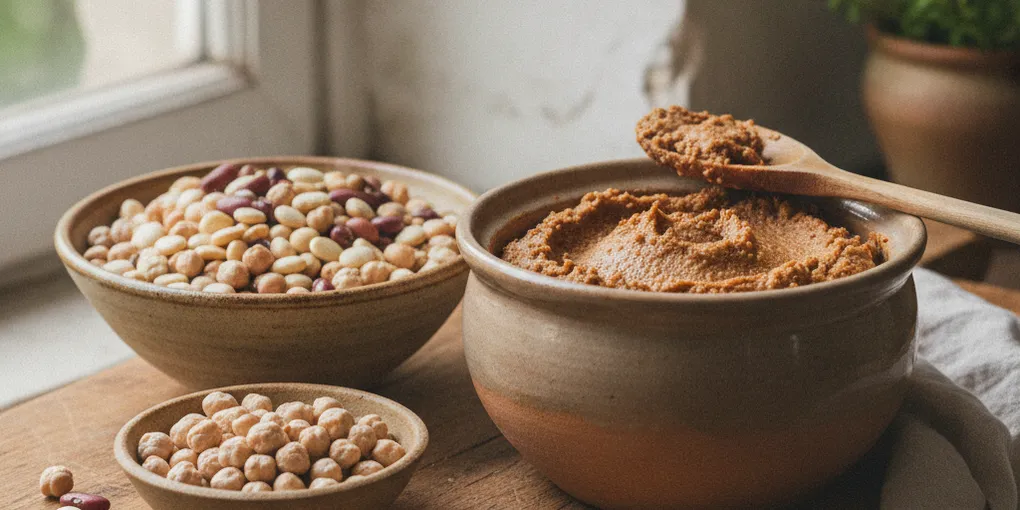
Yet a study has quietly emerged to challenge that very premise. What happens when you make miso using chickpeas, lupins, or adzuki beans instead of soybeans? A research team at the University of Lisbon in Portugal spent 18 long months investigating this question. Their findings were published in the academic journal Foods in December 2025.
This time, I’d like to use this research as a lens through which to take a fresh look at the depth of miso as a fermented food.
Why Study “Miso Without Soybeans”?
Miso is made by mixing soybeans, koji (rice or barley mold), and salt, then allowing microorganisms to work their magic over time. Through a slow fermentation process, the proteins in soybeans break down into umami compounds—the very essence that gives miso its distinctive flavor.
So why bother making miso from beans other than soybeans?
There are several reasons behind this research direction. One is a growing interest in sustainability. Global food production is shifting toward reducing dependence on specific crops and instead leveraging the resources of each region. The research team focused their attention on legumes that aren’t necessarily high in market value but grow readily in their local areas. Chickpeas, lupins, and adzuki beans are exactly the kind of “locally rooted beans” they were interested in.
Another motivation is the hope for salt reduction. Miso is admittedly a high-salt food. By reconsidering both the raw materials and the fermentation mechanism, researchers hoped to explore the potential for creating products with lower sodium content.
What 18 Months of Observation Revealed
The research team made miso from chickpeas, lupins, adzuki beans, and soybeans (for comparison), then carefully tracked how fermentation progressed over the full 18-month period.
Their focus was on how fermentation advances.
During miso-making, microorganisms like lactic acid bacteria work to gradually make the environment more acidic. The study confirmed that salt-tolerant lactic acid bacteria called Tetragenococcus halophilus became active, causing the pH (acidity level) to drop from 5.8 to 4.9. This acidification plays a crucial role in suppressing unwanted microbes and developing the miso’s flavor profile.
The result? Miso made from legumes other than soybeans showed fermentation characteristics remarkably similar to traditional soybean miso. In other words, one clear answer emerged: “Miso doesn’t have to be made from soybeans.”
The Chickpea Miso’s Surprising Potential
What was particularly fascinating was the miso made from chickpeas.
According to the research team, chickpea-based miso showed the highest metabolic activity, containing greater amounts of soluble proteins, phenolic compounds, reducing sugars, and organic acids compared to the other beans tested.
Let me break this down a bit. Soluble proteins are compounds involved in umami and nutrition. Phenolic compounds are found in plants and are the subject of ongoing research into antioxidant properties. Organic acids relate to acidity, shelf stability, and depth of flavor. The fact that these were produced in higher quantities suggests that chickpeas hold considerable promise as a fermentation substrate.
That said, I want to add an important caveat here. This research examined the mechanisms of fermentation and changes in chemical composition, but it did not test whether eating chickpea miso produces health benefits in people. We’re still at the stage of scientifically demonstrating the potential of the ingredient itself. I think it’s important to be honest about this distinction.
The Universal Nature of Fermentation
What this research teaches us is the remarkable depth and flexibility of fermentation as a practice.
Miso was born and nurtured in Japanese food culture, but the fundamental principle at its heart—using microorganisms to ferment beans—carries a universality that isn’t bound to any single ingredient. Soybeans are just one option. When conditions are right, microorganisms will do their work regardless. That a Portuguese research team chose to shine a light on miso, a traditional Japanese food, is itself proof that fermentation attracts people across national borders.
And that universality offers a subtle suggestion for our own dinner tables. When the type of bean changes, so too do the compounds produced and the flavors that emerge. Fermented foods are a world open to diversity, not locked into a single “correct” answer.
How to Bring This into Your Daily Kitchen
Of course, chickpea miso won’t suddenly appear on store shelves. This is a research-stage finding, and practical application will take time.
Still, this study offers us gentle guidance for how we might approach miso differently going forward.
One shift is in how we view miso itself. That simple bowl of miso soup you have every day is a sophisticated fermented food created through the patient work of microorganisms over long months. It deserves our renewed respect.
Another is greater awareness of salt content. Salt reduction was part of the research’s motivation, after all. Miso has a healthy image, but it’s high in sodium—that’s a fact. Making stronger dashi broth, using less miso, adding more vegetables to the soup—these traditional tricks are also wisdom about living well with salt.
The research’s question—“Does it need to be soybeans?”—is really another way of saying “The possibilities of fermentation are still expanding.” I’m curious to see what new misos might emerge next. Let’s wait for them with quiet anticipation.
A Note from Toshi
Reading this research has given me a chance to look at miso with a wider perspective.
For me, miso has always meant soybeans. The aroma of miso soup, the deep complexity of miso-pickled vegetables, the subtle umami boost of a dab of miso at the end of cooking—I’ve always thought all of this comes from soybeans, koji, and salt. So the idea of fermenting miso from chickpeas, lupins, or adzuki beans felt genuinely surprising and fresh.
But thinking about it more, perhaps the real essence of miso isn’t “soybeans” at all, but rather the fermentation process itself—the way microorganisms gradually transform beans and grains over time. Even if the raw ingredient changes, koji molds, yeasts, and lactic acid bacteria still do their work, developing umami and fragrance through time. Seeing it this way, I realize that miso as a fermented food still has room to grow.
What struck me most was that a Portuguese research team chose to focus on miso, a distinctly Japanese food. Miso feels almost inseparable from Japanese food culture itself, yet its underlying mechanisms are being studied by researchers around the world. Knowing that fermentation as a subject captivates scientists globally makes me feel a quiet sense of pride.
At the same time, I don’t think we should jump to the conclusion that “newer bean misos are better than soybean miso.” This research explored the possibility that fermentation can happen with chickpeas, lupins, and adzuki beans—it didn’t settle questions about taste, safety, product stability, or how well these misos would work in everyday cooking. And crucially, this wasn’t a study of human health effects. I think we need to be cautious in how we interpret these findings.
The results showing higher soluble proteins, phenolic compounds, and organic acids in chickpea miso are genuinely intriguing. It suggests chickpeas have interesting potential as a fermentation substrate. But that’s a finding about compounds and fermentation characteristics—whether eating these misos would affect human health requires different research. I’ve learned that it’s important not to immediately leap from research findings to daily health claims.
I was also struck by the salt-reduction angle. Miso is delicious and has been cherished for centuries, but it’s definitely salty. Personally, while I love miso soup, because it’s something I eat regularly, I think it matters to pay attention to brewing strong dashi broth, adding plenty of vegetables, and being slightly mindful of how much miso I use. Rather than simply assuming fermented foods are healthy, I think it’s wise to also keep salt intake in mind.
This research points toward new miso possibilities while reminding us of the remarkable nature of traditional soybean miso. Over months and years, koji molds, yeasts, and lactic acid bacteria work to transform soybeans into something with profound depth. We drink our miso soup without thinking, yet it’s actually a very sophisticated fermented product. We tend to overlook this because it’s so familiar.
I believe that honoring tradition and exploring new possibilities aren’t at odds with each other. We can cherish traditional soybean miso while also paying attention to research on fermenting chickpeas and other beans. This approach will only deepen our food culture.
Of course, some ingredients like lupin require particular caution—some people may have allergies. For new foods to be widely adopted, careful attention to safety, labeling, and consideration for all eaters is essential. Introducing new fermented foods requires this kind of thoughtful, step-by-step approach.
Through this article, I’ve come to appreciate that fermented foods are both “things that have existed for centuries” and a field with tremendous room for further research. Miso is at once a fully realized traditional food and something with potential to reveal new facets depending on ingredients, microorganisms, and fermentation conditions.
The next time I have a bowl of miso soup, I think I’ll pause to consider the microscopic work of fermentation happening within the familiar soybeans I’ve known all my life. And I’ll also remember that somewhere in the world, researchers are quietly advancing studies on new miso made from chickpeas and adzuki beans.
Perhaps fermentation isn’t meant to preserve tradition in amber, but rather to unfold and expand it over time. I want to continue cherishing the miso of our ancestors while quietly anticipating what new legume-based misos might bring. That’s how I’d like to enjoy the world of fermentation going forward.
Toshi / 56 years old, passionate about fermentation, gut health, and running
※ This article is based on personal experience and publicly available information. It is not intended to diagnose, treat, or prevent any disease. If you have health concerns, please consult a doctor or registered dietitian. See our Disclaimer.