⏱ About 13 min read
Lactic Acid Bacteria Found on Vegetables, Fruits, and Edible Flowers | A Review Exploring Microbial Sources for Fermentation
About This Article: This piece introduces a review paper that systematizes research on lactic acid bacteria associated with plants. It does not mean that all microorganisms clinging to raw vegetables, fruits, and flowers are beneficial or safe. Nor does it encourage homemade fermentation done on a whim.
Yogurt. Pickled vegetables. Miso. Kimchi.
Whenever fermented foods come up, there’s one character that always takes center stage: lactic acid bacteria. These microbes break down sugars to produce acid, creating the distinctive flavors and tanginess that define fermentation. They’re the true stars of the show.
But where do these lactic acid bacteria actually come from? Here’s something that might surprise you: the very fresh fruits and vegetables we eat every day—along with edible flowers—are home to countless lactic acid bacteria living right on their surfaces. A comprehensive review paper systematically organizing this “plant-derived lactic acid bacteria” was published in the academic journal World Journal of Microbiology & Biotechnology in 2026, authored by a research team in Italy.
Today, I want to trace this unexpected relationship between fermentation microbes and plants, using this paper as my guide.
Fresh Plants: Tiny Homes for Microbes
We don’t often think about it, but the surface of vegetables and fruits is actually a thriving “habitat” where countless microorganisms live.
Through soil, air, and water, various bacteria find their way to plants and establish their own miniature ecosystem there. The review describes this surface of fresh produce as a “space hosting a complex microbial community.”
Lactic acid bacteria are members of that community. They live on plants, feeding on sugars and other nutrients. When we eat raw vegetables or fruit, we may inadvertently consume some of these surface microorganisms along with our meal. However, since plant surfaces are home to many microbes beyond lactic acid bacteria, it’s important to wash raw produce properly and handle it hygienically.
Fruits, Vegetables—and “Edible Flowers”
What’s particularly interesting about this review is that it shines light not just on fruits and vegetables, but also on a somewhat less common source: edible flowers.
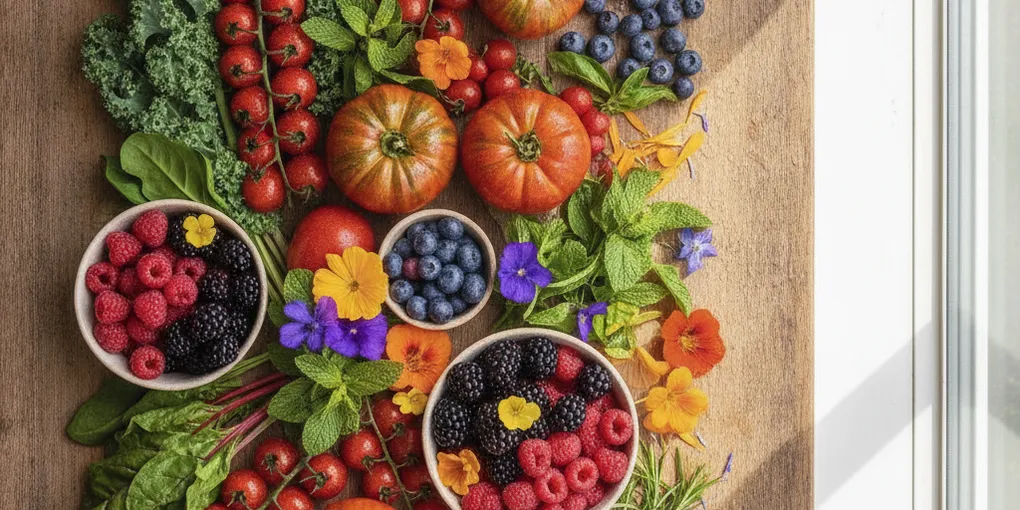
Flowers that are safe to eat are sometimes used as garnishes to add color to dishes. It turns out that diverse lactic acid bacteria can be found on the surfaces of these flowers too. The research team compiled and organized these plant-derived lactic acid bacteria across all these sources, highlighting their remarkable diversity.
Here, it’s important to note that “edible flowers” refers to flowers confirmed as safe to eat and cultivated or sold specifically for culinary purposes. This doesn’t mean you should eat decorative flowers or flowers picked from the wild just because they look pleasant. Some plants have inherent toxins, and flowers not intended for consumption may have been treated with pesticides unsuitable for human ingestion. It’s crucial not to make assumptions and eat something based on appearance alone.
What’s also intriguing is that the paper itself positions this as “the first review offering an integrated overview of lactic acid bacteria related to plants.” Until now, knowledge about these bacteria has been scattered across various studies. This review brings all those pieces together into one comprehensive picture.
What Are These Plant-Dwelling Lactic Acid Bacteria Actually Doing?
So what role do lactic acid bacteria play while living on plants? The review identifies three major aspects.
First, there’s fermentation itself. The bacteria break down sugars to produce acid, keeping the environment slightly acidic. This is precisely what sets the stage for fermented foods like pickles.
Second is something called bioprotection. The acid and other compounds produced by lactic acid bacteria may, under certain conditions, inhibit the growth of some undesirable microorganisms. However, this doesn’t mean that the presence of lactic acid bacteria guarantees food safety, nor does it replace sterilization.
Third is the potential to produce compounds with biological activity. But here’s the important caveat: this is still in the exploratory research phase. We haven’t yet confirmed that these compounds have specific health benefits. We should approach this point with appropriate caution.
This Force Is Already at Work on Your Table
The work of plant-dwelling lactic acid bacteria isn’t confined to distant research laboratories. It’s already alive and well at our everyday dining tables.
Take sauerkraut (fermented cabbage), Korean kimchi, or sunki-zuke (a fermented vegetable pickle from Nagano). Many of these ferment successfully without anyone adding lactic acid bacteria afterward. Why? Because the vegetables themselves—the raw materials—naturally host lactic acid bacteria on their surfaces.
In traditional natural fermentation, microbes from the ingredients and the production environment do their work under carefully managed conditions: the right salt content, temperature, time, and hygiene. But this doesn’t mean that leaving things at room temperature without any care will safely produce fermented food. When making fermented foods at home, you need to follow trusted recipes and handle both containers and ingredients with proper cleanliness.
In other words, our ancestors harnessed the power of plant-derived lactic acid bacteria through practical experience, all without knowing these microbes existed. This review essentially maps out the microbial world operating behind those results that our forebears observed firsthand.
Potential Applications in Food Making
This plant-derived lactic acid bacteria opens up several possibilities for future food production, according to the review.
One possibility is the development of new fermented foods and fermented beverages. If researchers discover strains with unique characteristics different from those traditionally used, the range of flavors could expand. Bacteria derived from fruits or flowers might produce entirely new aromas or acid profiles we’ve never tasted before. They could also serve as candidates for probiotic cultures.
That said, just because a lactic acid bacterium is found in plants doesn’t mean it can be used directly as a probiotic. Each candidate requires individual testing: safety profiles, characteristics as a bacterial strain, required dosage, and efficacy in humans must all be confirmed.
Another noteworthy angle is sustainability. Think of vegetables that don’t meet cosmetic standards and can’t be sold, or the massive amounts of pomace left over from juice production. Plant byproducts like these often still contain usable lactic acid bacteria. If we can harness them, we’re giving new value to resources that would otherwise end up in the trash. It’s a direct response to the food waste challenge of our time.
Still Frontier Territory
That said, this is a review outlining promising possibilities—not something heading directly to practical application anytime soon.
We need to determine which strains truly are useful and safe to use. We need to understand how lactic acid bacteria cope with and adapt to environmental stress in the highly dynamic plant environment, looking at this through the lens of genomics and ecology.
Still, the perspective that familiar vegetables, fruits, and flowers could be a “new source” of fermentation microbes feels genuinely fresh. It tells us that fermentation—this ancient practice—continues to evolve and expand through new encounters with microbes.
Next time you pick up a colorful vegetable or fruit, I hope you’ll take a moment to imagine the tiny microbes quietly living on its surface.
From Toshi
When I hear “lactic acid bacteria,” I’ve always pictured the bacteria inside yogurt or probiotic drinks. Or I’ve thought of them as microbes working within foods already fermented—miso, pickles, kimchi.
But reading through this article, I learned that these lactic acid bacteria are found not just in finished fermented foods, but on vegetables, fruits, and edible flowers before they even become fermented products. Fermentation doesn’t spontaneously begin in a factory or sealed container—it emerges from connections with the plants themselves and their surrounding environment. That’s what struck me as fascinating.
A tomato or cabbage growing in a field looks like a single, simple food item. But its surface and interior harbor an invisible world of microorganisms. Through contact with soil, water, air, insects, and human hands, microbes gather and create a miniature ecosystem.
We see a tomato as one vegetable, but from the perspective of a microorganism, it’s a space where numerous living things coexist.
Yet just because microorganisms live on a plant doesn’t mean they’re all beneficial to our health. Lactic acid bacteria are just one part of the microbial community on a plant’s surface. There are many other bacteria, yeasts, and molds present. Some of them spoil food or could be unwelcome to human consumption.
It’s dangerous to think, “It’s natural, so it must be safe” or “If lactic acid bacteria are there, I should eat it without washing.” Raw vegetables and fruits need to be washed properly and handled with clean hands and utensils. The basic food safety practices we’ve always followed remain unchanged, even after learning this science.
I think it’s important to receive scientific information together with actions that protect our daily safety.
Another thing that felt fresh to me in this review was the mention of “edible flowers.”
When a dish is garnished with a flower, it instantly becomes more beautiful and elegant. The fact that lactic acid bacteria are found on flower surfaces too—and that they’re now being researched as potential sources for new fermentation cultures—speaks to the incredible diversity of plants.
But the most important thing about the term “edible flower” is this: not all flowers are edible.
Flowers fall into categories: those that can be eaten and those that cannot. Even within edible plant species, certain parts may not be suitable. Flowers sold by florists are often grown for ornamental purposes, not for consumption. Flowers whose variety you’re unsure of, or those growing by roadsides, in parks, or gardens shouldn’t be picked and eaten based solely on appearance.
This research explores lactic acid bacteria found in plants confirmed as edible. It’s not about going out and gathering wildflowers to ferment them. This distinction is crucial, and readers need to understand it clearly.
The same caution applies to fermented foods.
Our ancestors didn’t know the name “lactic acid bacteria,” yet through experience with storing vegetables, they learned that tanginess would develop and ingredients would transform. Through repeated attempts, through trials and errors, they adjusted the amount of salt, temperature, time, containers, and seasonal factors.
That knowledge was passed down and became regional fermentation traditions: pickles, kimchi, sauerkraut, sunki-zuke. I find the heart of fermentation in this.
Microbes were being harnessed in daily life long before humans even discovered them. Science came later, explaining the bacteria working behind the methods that ancestors had found through experience.
At the same time, just because traditional fermentation exists doesn’t mean that sprinkling salt on vegetables and leaving them at room temperature will magically produce safe fermented food.
Only desirable lactic acid bacteria might not flourish. If salt content, temperature, oxygen levels, time, ingredient condition, and container cleanliness aren’t right, spoilage or undesirable microbes could proliferate. Appearance and smell alone may not tell us whether something is safe to eat.
If you’re making fermented foods at home, follow a trusted method with a proven track record. If you notice unusual colors, mold, container bloating, or smells and conditions that seem off, you should exercise judgment and not force yourself to eat it thinking, “It’s fermented, so it must be fine.”
Fermentation and spoilage are both processes where microbes transform food. Guiding ingredients toward a state that’s safe for humans and delicious to enjoy requires long experience and proper management.
This review also mentions the possibility of applying plant-derived lactic acid bacteria to new food production.
Even bacteria given the same name—lactic acid bacteria—have different characteristics depending on the strain. The speed at which they produce acid, the temperatures they can tolerate, the sugars they can utilize, the aromas and compounds they produce—each has its own personality.
Bacteria found on fruits, bacteria from vegetables, bacteria from edible flowers. Among these, there might be strains that create flavors and aromas we’ve never encountered. There might be bacteria well-adapted to specific ingredients, helping ensure stable fermentation.
However, just because a lactic acid bacterium came from a plant doesn’t mean it can be used directly in food. Many confirmations are necessary: Is it safe for human consumption? Does it produce undesirable compounds? Does it remain stable during storage?
About the term “probiotic candidate”—candidates remain candidates. Just because bacteria tolerate acid or bile in a test tube doesn’t mean eating them will deliver health benefits for humans. Each bacterial strain requires safety verification and human studies before we truly understand what it can do.
I think it’s important to stay hopeful about research potential while refraining from describing unconfirmed possibilities as if they were established benefits.
I was also drawn to the research on utilizing plant byproducts.
Vegetables that don’t meet size or shape standards and can’t be sold, the pomace left after juice production, skins and leaves discarded in food processing—these retain potential usable compounds and microbes. If we could safely recover them and apply them to new fermented food or starter culture research, we’d give new value to what was once waste. That’s a compelling vision.
But again, this isn’t about simply eating discarded parts. We’d need to verify storage conditions, contamination risks, pesticide use, toxins, allergies, and establish safe processing methods. Even with the goal of reducing food waste, safety can’t take a back seat.
What I felt most strongly from this review is that the plant we see in our everyday life shows us only one side of the story.
Beyond color, shape, aroma, and taste lies a hidden diversity of microorganisms. Fermented foods represent a culture of bringing that microbial activity into human life and nourishment.
A bowl of miso soup, a plate of pickled vegetables, a single piece of fruit. Behind each lies a whole connected chain: the field, the soil, water, climate, human hands, and microbes. When we look beyond just the food on our table and imagine the long journey it took to get there, fermentation becomes even more profound.
In nature, there are still countless unknown bacteria. Finding the ones that can help with food production, confirming their properties, and developing them into forms we can safely use—that’s painstaking work.
Rather than rushing to claim dramatic health effects, the real work is investigating, one by one: “Where are these bacteria? What kinds are they? What can they do?” It’s this accumulation of knowledge that will lead to genuinely new fermented foods in the future.
Vegetables, fruits, and edible flowers are doorways to exploring lactic acid bacteria potential. But we shouldn’t assume that everything natural is unconditionally safe. We must cherish hygiene and scientific verification. Holding onto that carefulness, I want to continue watching with genuine curiosity the small world created by plants and microbes.
Toshi / 56 years old, lover of fermentation, health, and running
※ This article is based on personal experience and publicly available information. It is not intended to diagnose, treat, or prevent any disease. If you have health concerns, please consult a doctor or registered dietitian. See our Disclaimer.