⏱ About 9 min read
Why Does Miso Become Miso Without Koji? The Rare Traditional Miso "Nesashi Miso" and the Latest Science of Natural Fermentation
Most people think Japanese miso is made with koji.
And it’s an understandable assumption. Koji mold (Aspergillus oryzae) is indispensable in miso production. It breaks down the proteins in soybeans, converts starches into sugars, and creates that complex umami and sweetness we know so well. No koji, no miso—that’s what modern “common sense” tells us.
But Japan has a miso that exists outside that conventional wisdom.
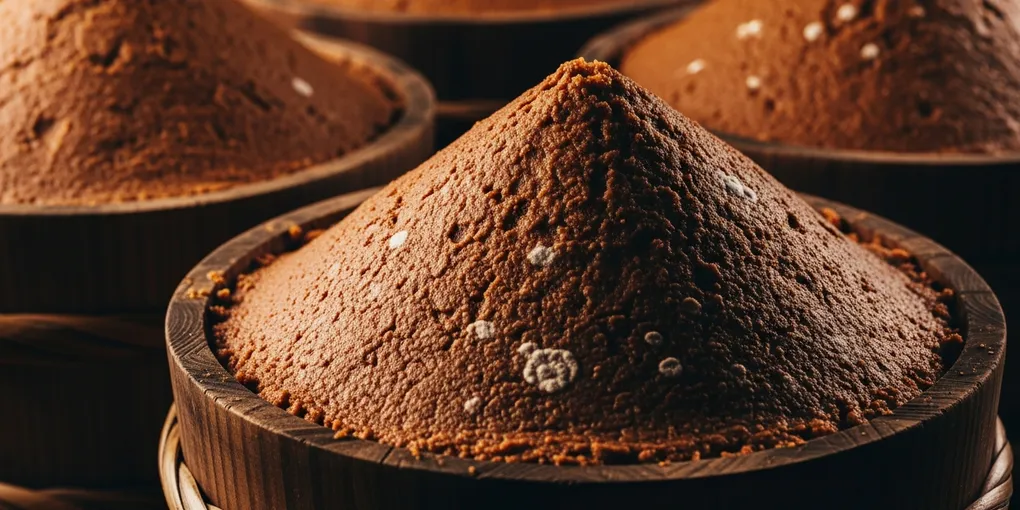
No koji. No inoculation. Just natural microorganisms doing their work, maturing slowly over a minimum of three years. That’s “nesashi miso.”
On January 30, 2026, a paper published in the academic journal Frontiers in Microbiology scientifically and comprehensively analyzed the microbial ecosystem of nesashi miso for the first time (PMC ID: PMC12901402).
What is Nesashi Miso?
Nesashi miso is a peculiar presence among fermented foods that still exist in Japan today.
The typical miso-making process follows a rough sequence: “cultivate koji mold on rice, barley, and soybeans → mix in salt and soybeans and set up fermentation → ferment and age.” The koji mold (Aspergillus oryzae) takes the lead role in fermentation, and the product is ready in a few months to a year.
Nesashi miso diverges fundamentally from this process. It uses no koji at all; microorganisms naturally present in the environment handle the fermentation instead. You might call it “self-seeding” fermentation.
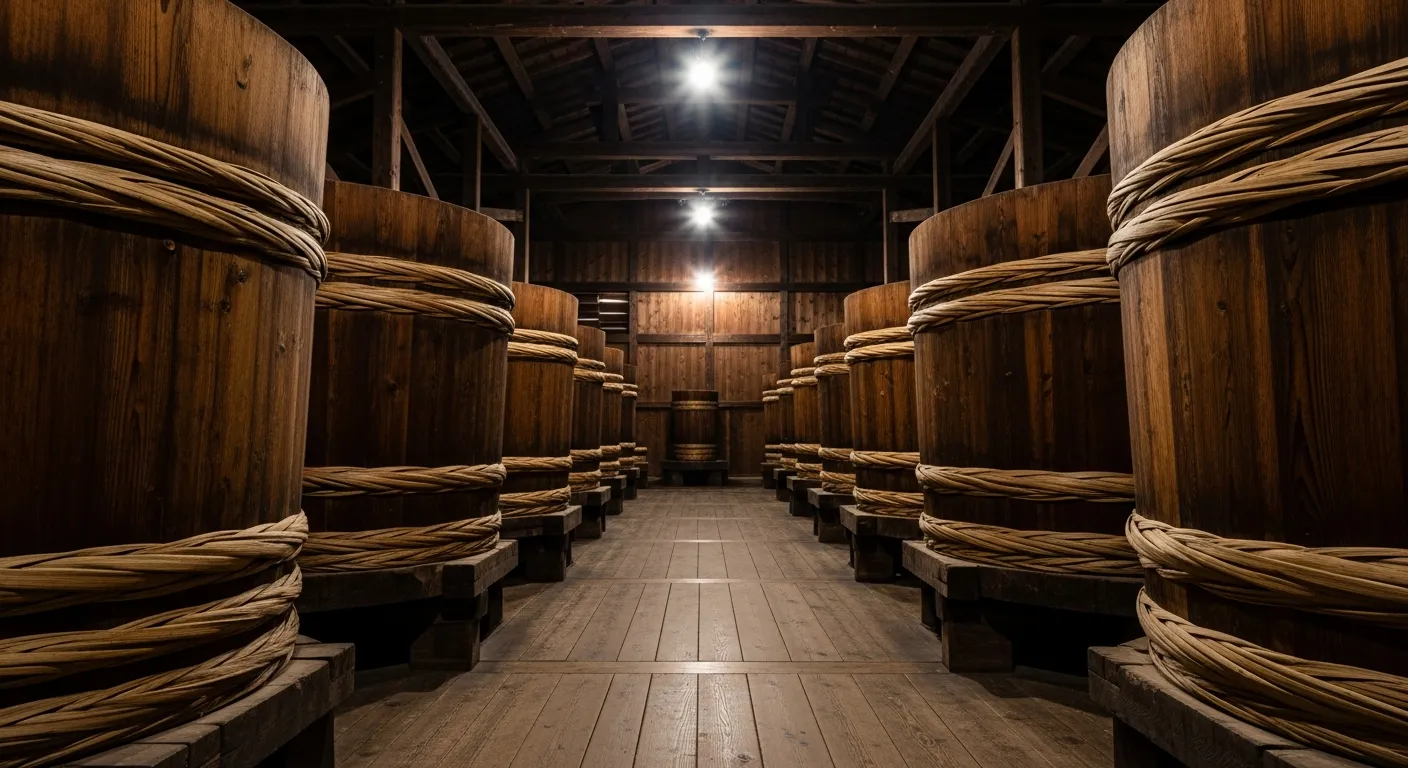
Production happens during the deepest winter, from January through February. The aging period lasts at least three years. Some batches take five years or more to complete. During all that time, no starter culture is added from outside. The warehouse environment, the soybeans themselves, the maker’s hands—everything becomes a source of microorganisms, and complex fermentation unfolds slowly.
From the perspective of modern, efficiency-driven food manufacturing, this method might seem impractical. Yet science is only now beginning to open the door to understanding what actually happens during those long years.
Not Koji, but Mucor Plumbeus Was the Star
What the research revealed most clearly was the true identity of the microorganism driving fermentation in nesashi miso.
The analysis showed that the microbial community dominating nesashi miso was a filamentous fungus called Mucor plumbeus.
Mucor is a type of mold. Like koji mold (Aspergillus), it’s a filamentous fungus, but it belongs to a completely different genus. It’s a fungus that isn’t typically used in standard miso-making. So why does it become the leading player? Because there’s no “competing” koji mold. In a manufacturing environment without koji, the Mucor naturally present in soybeans and warehouse environments proliferates dominantly. The result is a completely different microbial ecosystem from ordinary miso.
In addition to Mucor, filamentous fungi from the Penicillium genus were also detected. This is another species that doesn’t normally appear in miso. The microbial world inside nesashi miso turned out to be completely different from what we typically imagine when we think of “microbes in miso.”

Metagenomic Sequencing Finally Revealed the Invisible World
The breakthrough in this research was the use of a culture-independent approach.
In traditional microbiology research, the dominant method was “culture-based”—growing samples on growth media and analyzing the resulting microbes. But this method has limitations. The microbes that grow on media represent only a tiny fraction of the total microbial population. Natural environments and fermented foods contain countless microorganisms that simply won’t grow on standard media.
The research team employed shotgun metagenomic sequencing. They directly read all the DNA in a sample and comprehensively analyzed what microbes were present and in what quantities. This cutting-edge technology allows you to see the entire microbial community of a fermented food “as it is,” including microbes that can’t be cultured.
Additionally, they conducted long-read sequencing using Oxford Nanopore technology, decoding the complete genome of the main Mucor strain. This approach is effective for understanding the full genetic makeup of a microorganism with high precision.
By combining these two approaches, the microbial ecosystem of nesashi miso was revealed in detail for the first time. It was the moment when science finally gave a serious answer to the question “What lives inside nesashi miso?”
The analysis went even further, conducting principal component analysis (PCA) comparing the metagenomic data from 65 fermented foods and environmental samples worldwide. This clarified exactly which fermented foods globally are most similar to nesashi miso in terms of microbial composition.
The Evolutionary Significance of Fungi “Adapted” to Food Environments
Genome analysis revealed another crucial finding.
The Mucor strain isolated from nesashi miso possessed unique genes related to amino acid metabolism compared to Mucor strains found in natural environments like soil and air. Genes involved in tyrosine metabolism were particularly distinctive.
What does this mean?
Mucor naturally exists widely in soil and air. But by being repeatedly exposed to the nesashi miso-making environment, the microbe may have developed genes to survive within the food and contribute to fermentation.
The research team describes this phenomenon as “adaptation to food niche.” Long-standing fermented food production environments have functioned as a kind of “cultivated microbial reservoir”—they select microbes, nurture them, and build unique ecosystems. That’s what the paper suggests.
Even more interesting is that the PCA analysis showed nesashi miso’s metagenome clustering with the Chinese traditional fermented starter daqu. Daqu is used in brewing Chinese spirits like baijiu and Shaoxing wine, and it features natural co-existence of various filamentous fungi, yeasts, and bacteria rather than a single koji strain. The shared characteristic of “natural fermentation without koji” appeared as similarity in microbial ecology.
This is a discovery suggesting that traditional natural fermentation foods may share common microbial principles across cultures and regions.
The Meaning of “Three Years or More”
Standard miso becomes a finished product in a few months to a year. So why does nesashi miso take more than three years?
Koji mold has high enzyme-producing capacity. It secretes large quantities of starch-degrading enzymes (amylase) and protein-degrading enzymes (protease), propelling fermentation forward rapidly. With koji present, fermentation can be completed in a short timeframe.
Mucor fungi don’t have enzyme activity as strong as koji mold. Natural microbial communities build fermentation slowly, so it takes much longer to reach the same “finished” state.
But this “slowness” might not be a drawback. During the long fermentation period, diverse microbes participate, and complex metabolic reactions accumulate over years. The complexity of flavor, compounds, and aroma that emerge as a result might reach a realm that short-term fermentation simply cannot attain.
While research hasn’t yet fully illuminated this, the current study hints that there may be scientific meaning to “taking time.” The potential significance of a long fermentation period becomes apparent.
The Scientific Significance of Japan’s Traditional Fermented Foods
This research carries meaning beyond the individual food of nesashi miso.
Japanese traditional fermented foods—miso, soy sauce, sake, natto, pickles—have been refined over long periods through “empirical” trial and error. Long before the existence of microbes was even understood, artisans experimented repeatedly and discovered optimal manufacturing methods. Science continues to discover meaning within those methods after the fact.
Standard miso using koji has been extensively researched in terms of its microbial ecosystem. But nesashi miso, which doesn’t use koji, remained invisible to scientific scrutiny for a long time. This research finally shines a light on that blind spot.
“Ancient craft techniques hold within them the methods of microbial community assembly,” the paper states. Tradition is not mere habit—it may carry both rationality and uniqueness from the perspective of microbial science.
Summary
Nesashi miso uses no koji at all, relying instead solely on naturally occurring microorganisms to ferment over three years or more—a rare traditional Japanese fermented food. When researchers combined metagenomic sequencing and genome analysis to examine it for the first time, they discovered that Mucor plumbeus is the primary player driving fermentation, that it carries unique amino acid metabolism genes as an adaptation to the food environment, and that this production setting functions as a kind of microbial “reservoir.”
Microorganisms that were never anticipated in modern miso-making have, within Japanese tradition, formed their own distinct fermentation ecosystem. This fact reveals that our understanding of “fermented foods” is still just scratching the surface.
Three years or more. Without koji. Time and nature, making one miso.
From Toshi
“Miso is made with koji.”
Reading this research felt like that premise quietly crumbling away.
Though I might have heard about nesashi miso somewhere in passing, I’ve never encountered a study that examined so deeply—with such scientific rigor—what actually happens inside it. It truly is the “visualization of an invisible world.”
What struck me most was the simple fact that the star of fermentation wasn’t koji mold, but Mucor plumbeus.
We unconsciously believe that “umami = the work of koji mold.” But this research shows that this role isn’t fixed to a specific microbe—other microorganisms can assume that role depending on the environment. In other words, fermentation isn’t so much “a technology that uses specific fungi” as it is “a culture of designing environments.”
What’s even more fascinating is that the microbes in nesashi miso aren’t merely a random assemblage of nature, but rather organisms that have evolved through “adaptation to the food environment.”
This isn’t chance.
Through years of repetition—the same warehouse, the same preparation process, the same hands—microbes are selected, they survive or disappear, they are cultivated.
Is it humans who are raising the microbes?
Or are the microbes choosing their environment?
That blurred boundary is the very essence of fermentation’s depth, I think.
The meaning of those three years or more also weighs heavily on my mind.
In modern times, we measure value by speed: “How quickly can we make it?” But nesashi miso stands in complete opposition to that. There’s a kind of complexity that can only emerge by refusing to shorten the time.
That’s a value that efficiency simply cannot measure.
Fermentation isn’t about speed—it’s about layering.
Generations of microbes, accumulated metabolism, interaction with environment. All of it builds up across the layer we call time.
And finally, the greatest significance this research demonstrates is that “tradition is not irrational.”
Rather, science simply hadn’t caught up yet. There existed clear microbiological logic within it all along.
The artisan’s experience wasn’t accident—it was the accumulation of “experiments” conducted across long years.
Nesashi miso isn’t merely a rare food product.
It’s an existence that demonstrates another form of the relationship between microbes and humans.
No koji. No starter culture added.
Yet fermentation still happens.
What’s present there isn’t so much “leaving it to nature” as it is
“an environment designed together with nature.”
The more you learn about fermentation, the less you understand it.
And that “lack of understanding” is precisely what makes it fascinating.
Nesashi miso has deepened that entrance even further for me.
※ This article is based on personal experience and publicly available information. It is not intended to diagnose, treat, or prevent any disease. If you have health concerns, please consult a doctor or registered dietitian. See our Disclaimer.